

Stop guessing on circuit breaker sizes. Stop wasting time decoding complex spec sheets for your PowerFlex drives. In any industrial setting, getting the electrical load wrong costs time, money, and risks safety. The core of a reliable and efficient system is a solid understanding of amps. Get your amperage calculations right, and you prevent costly downtime and equipment failure. Get it wrong, and you risk damaging expensive components that can cost thousands of AUD to replace, not to mention the lost production.
This practical guide cuts through the theory. We deliver the direct information you need to master amperes for your Australian industrial applications. You will learn exactly how to calculate amp requirements for motors and drives, confidently size the correct wires and breakers, and finally understand the practical difference between amps, volts, and watts. Master these essentials to select the right components, avoid overspending, and get the job done right—the first time.
What Are Amps? The Fundamentals of Electric Current
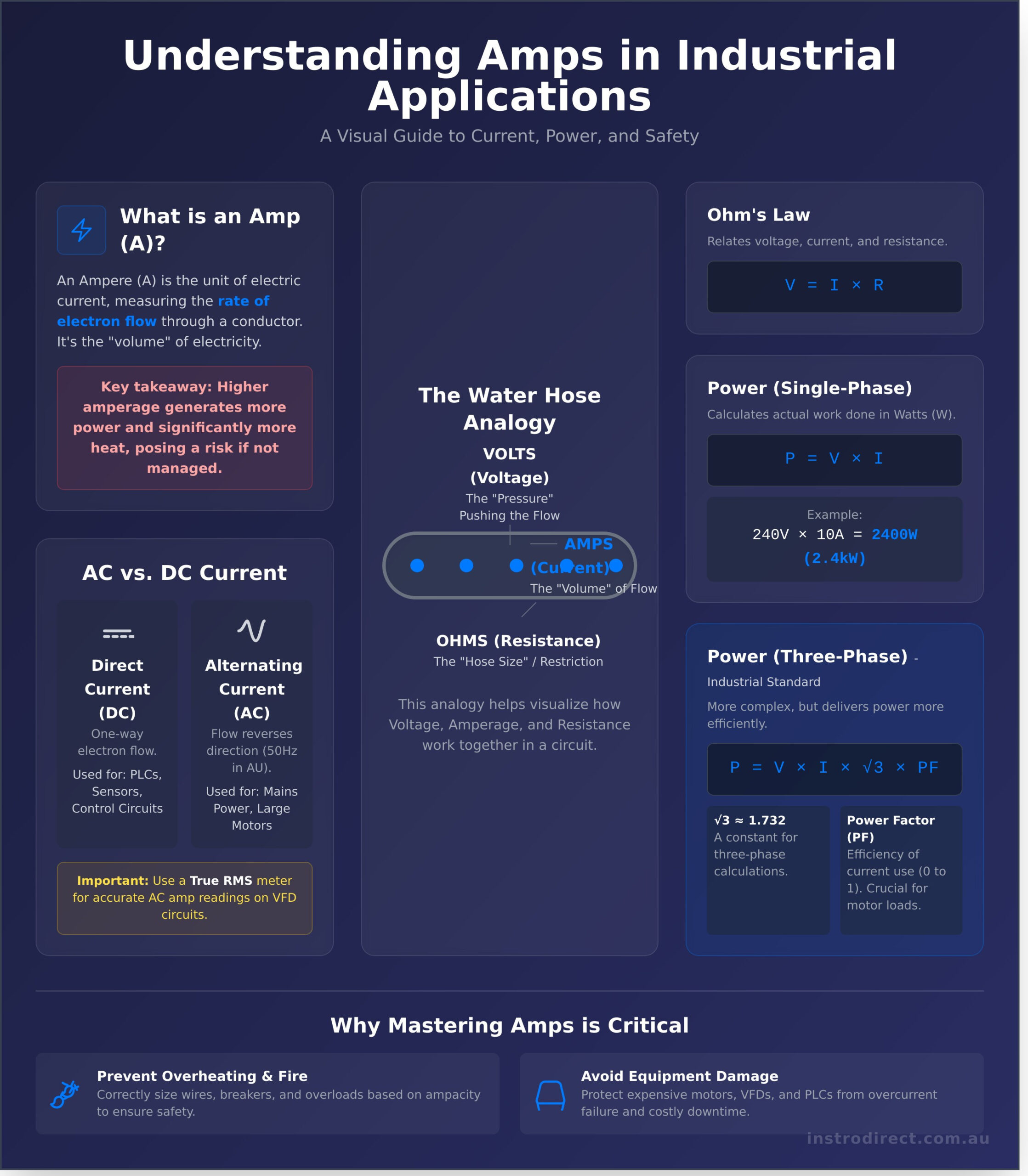
An amp, or ampere (A), is the standard unit of measurement for electric current. In simple terms, current is the rate at which electric charge flows past a point in a circuit. In an industrial setting, correctly measuring and managing current is critical for sizing cables, protecting motors with overloads, and troubleshooting faults. Too much current generates excess heat—a primary cause of equipment failure and electrical fires. The unit is named after French physicist André-Marie Ampère, a key figure in the field of electromagnetism.
Defining Amps: More Than Just a Flow
Electric current is the directed flow of electrons through a conductor, like a copper wire. The amp measures the quantity of these electrons. Technically, the ampere is defined as one coulomb of electrical charge (roughly 6.24 quintillion electrons) moving past a point in one second. It is crucial to understand that amps measure the volume of electrons flowing, not their individual speed. Higher amperage means more electrons are flowing, capable of delivering more power and generating more heat.
The Water Hose Analogy: Visualising Amps, Volts, and Ohms
To build a practical intuition, think of electricity like water flowing through a hose. This simplified model helps clarify how the three core electrical units work together:
- Volts (Voltage): This is the water pressure. It’s the force pushing the water (charge) through the hose (conductor).
- Amps (Current): This is the flow rate. It represents the total volume of water moving past a point each second.
- Ohms (Resistance): This is the size of the hose. A narrower hose restricts the flow, representing higher resistance.
AC vs. DC Amperage: Key Differences for Industrial Techs
In industrial automation and electrical work, you will encounter two fundamental types of current:
- Direct Current (DC): A constant, one-way flow of electrons. It’s used extensively in low-voltage control circuits, PLCs, sensors, and DC power supplies.
- Alternating Current (AC): The flow of electrons rapidly reverses direction. In Australia, our mains power is AC, cycling at 50 times per second (50Hz). It’s used to power facilities and run most large motors.
This distinction is vital for measurement. To get an accurate reading of AC amps, especially on circuits controlled by variable frequency drives (VFDs), you must use a multimeter or clamp meter with True RMS (Root Mean Square) capability. Standard meters can provide dangerously inaccurate readings on the non-sinusoidal waveforms produced by modern drives.
Amps, Volts, and Watts: The Power Triangle Explained
To make practical electrical calculations, you must understand the relationship between amps, volts, and watts. These three units are fundamentally linked in what is often called the “Power Triangle.” You cannot correctly size a circuit breaker, select a variable frequency drive, or specify a motor without knowing how they interact. Get these calculations wrong, and you risk inefficiency, equipment damage, or safety hazards.
These formulas are the key to correct component selection and system design.
Ohm’s Law in Practice: The Relationship Between Voltage, Current, and Resistance
Ohm’s Law is the foundational equation linking voltage, current (measured in amps), and resistance. It states that the current flowing through a conductor is directly proportional to the voltage across it, provided the temperature and other physical conditions remain unchanged.
- Formula:
V = I × R(Voltage = Current × Resistance) - Example: A simple resistive heater connected to a standard 240V Australian supply has a resistance of 24 Ohms (Ω). To find the current it draws, we rearrange the formula:
I = V / R
I = 240V / 24Ω = 10A
This shows that for a constant voltage, higher resistance will result in a lower current draw.
The Power Formula: How to Calculate Watts from Amps and Volts
While Ohm’s Law relates the flow, the Power Formula calculates the actual work being done or the energy being consumed. This is measured in Watts (W). Understanding power is critical for managing operational costs, as it directly relates to your facility’s energy consumption and production metrics and ultimately, your power bill.
- Formula (Single-Phase):
P = V × I(Power = Voltage × Current) - Example: A single-phase motor running on a 240V supply is drawing 10 amps of current.
P = 240V × 10A = 2400W
This is equal to 2.4 kilowatts (kW).
Single-Phase vs. Three-Phase Power Calculations
Most industrial and heavy commercial applications in Australia use three-phase power because it delivers more power more efficiently, especially for large motors. The power calculation for a balanced three-phase system requires an additional component.
- Formula (Three-Phase):
P = V × I × √3 × PF
Here, two new elements are introduced:
- The square root of 3 (√3 ≈ 1.732): This constant is used because the phases deliver power sequentially, not all at once.
- Power Factor (PF): This is a ratio (from 0 to 1) that describes how efficiently the current is being converted into useful work. Inductive loads, like motors, cause the current and voltage to be out of phase, reducing efficiency. A PF of 1 is perfectly efficient, while a motor might have a PF of 0.85. This value is crucial for accurate load calculations and avoiding utility penalties.
Why Amperage is Critical in Industrial Automation
In any industrial system, volts provide the potential, but amperage does the work. While all three metrics are related, as explained in the classic Amps, Volts, and Watts: The Power Triangle analogy, understanding amps is the most critical factor for ensuring operational safety. Too much current (overcurrent) generates excessive heat, leading to melted wires, fire hazards, and catastrophic equipment failure. A solid grasp of amperage is essential for correct system design and effective troubleshooting.
Sizing Wires and Cables Based on Ampacity
Every wire has a limit. This limit is called its ampacity—the maximum current a conductor can safely handle without overheating. Exceeding this rating is a direct path to system failure and a serious fire risk. In Australia, wire and cable sizing must comply with standards like AS/NZS 3008 to guarantee safety and prevent electrical fires caused by overloaded circuits.
This same principle of documented compliance applies to high-current industrial processes. In fabrication and welding, for instance, managing procedure and personnel documentation is crucial for safety and quality control; you can learn more when you visit SOCWeld.
Selecting Circuit Breakers and Fuses to Prevent Overcurrent
Circuit breakers and fuses are non-negotiable safety devices. They are designed to “trip” or blow when the current exceeds a specific amperage, cutting off the flow of electricity to protect the circuit. The breaker’s amp rating must be correctly matched to the wire’s ampacity and the equipment’s load. An incorrectly sized breaker can lead to nuisance tripping (too small) or fail to protect your VFDs and PLCs from damage (too large).
Understanding Motor Nameplates: FLA and LRA
For any motor-driven application, the nameplate provides two vital amperage values:
- FLA (Full Load Amps): The current the motor draws when operating at its rated horsepower under normal conditions.
- LRA (Locked Rotor Amps): The massive inrush of current drawn for a few seconds when the motor starts up. This can be 5-7 times higher than FLA.
Both values are crucial for selecting the correct motor starters, variable frequency drives, and overload protection. Ignoring LRA can lead to immediate tripping on startup, while miscalculating FLA can cause motor burnout over time. Ensure you have the right components by checking our deals on motor control and automation gear.
Applying Amperage Knowledge to Select Components
Understanding amperage is not just theory. It is critical for selecting the right industrial components. Matching the amp rating of your equipment to the demands of your application is the key to preventing overheating, premature failure, and costly operational downtime. Get this wrong, and you risk damaging expensive machinery. Get it right, and you ensure system reliability and safety.
Choosing VFDs Based on Motor FLA
When selecting a Variable Frequency Drive (VFD), its continuous amp rating must meet or exceed the motor’s Full Load Amps (FLA) listed on the motor nameplate. For example, a Rockwell PowerFlex drive will have two ratings: Normal Duty (ND) for light loads like fans and pumps, and Heavy Duty (HD) for demanding loads like conveyors or mixers. Always use the HD rating for tough applications. A correctly sized VFD also protects your motor by limiting the current draw during startup and operation.
Sizing Power Supplies for Control Panels
A control panel’s power supply is the heart of your automation system. A Siemens SITOP power supply, for instance, is rated in amps at a specific voltage, typically 24V DC. To size it correctly, you must calculate the total current draw of all connected components.
- PLC CPU: 0.5A
- I/O Modules (x4): 1.0A total
- HMI Touch Panel: 0.8A
- Total Required: 2.3A
Best practice is to oversize the power supply by 20-30%. For a 2.3A load, a 3A or 5A power supply provides a safety margin and allows for future expansion without needing a replacement.
Finding the Right Components for Your Amp Requirements
Every electrical component, from a circuit breaker to a contactor, has a maximum amperage rating. This information is always available on the product datasheet or listed in the specifications on the product page. Checking this detail ensures you buy the right part, first time. For great deals on parts that match your exact specifications, look no further.
Browse our range of Rockwell and Siemens components by specification.
Putting Your Amperage Knowledge to Work
Mastering the fundamentals of electrical current is essential for any industrial application. Remember that amperage dictates the flow of electricity and directly impacts component performance and safety. A clear understanding of how amps, volts, and watts interact is critical for selecting the correct drives, circuit breakers, and power supplies, preventing costly overloads and ensuring operational efficiency.
Now, turn theory into practice. InstroDirect helps Australian businesses get the right components at the best prices. Through our efficient Parallel Importing model, we deliver major brands like Rockwell, Siemens, and Schneider Electric at a significant discount, helping you reduce project costs. If you’re specifying a part and need to match the exact specs, our expert team is here to provide direct support by phone. Can’t find the part you need? Contact us directly for expert help.
Equip your facility with the right parts and power your success.
Frequently Asked Questions
What is the difference between inrush current and full load amps (FLA)?
Inrush current is the instantaneous, high surge of current a device, like a motor, draws the moment it is switched on. This spike lasts for only a fraction of a second. Full Load Amps (FLA) is the steady, continuous current a motor draws when operating at its rated power under normal conditions. Protective devices are designed to allow for brief inrush currents but will trip if the current remains high, exceeding the FLA rating.
Can you have voltage in a circuit without any amps?
Yes. Voltage is the electrical potential or pressure waiting to be used. Amps (amperage) is the flow of electrical current, which only occurs when a load is connected and the circuit is complete. For example, a standard Australian power outlet has 230 volts of potential ready, but zero amps are flowing from it until you plug in an appliance and turn it on. The potential exists without the flow.
How does ambient temperature affect a wire’s amp rating (ampacity)?
A wire’s amp rating, or ampacity, decreases as the ambient temperature increases. Electrical current generates heat in a wire, and this heat must dissipate into the surrounding environment. In hotter conditions, the wire cannot cool itself as effectively. To prevent the wire’s insulation from melting and creating a fire hazard, its maximum safe current capacity must be reduced. Australian standards (AS/NZS 3000) provide specific derating tables for this.
Why is my circuit breaker tripping if the load is below its amp rating?
A breaker can trip for several reasons beyond a simple overload. A short circuit will cause a massive, instantaneous current surge that trips the breaker immediately for safety. The issue could also be cumulative load from other undetected devices on the same circuit. For equipment like motors, using the wrong type of breaker can cause nuisance tripping during startup, as it mistakes the normal inrush current for a fault.
How do I safely measure amps in a live industrial control panel?
The safest and standard professional method is to use a clamp-on ammeter. This tool measures the magnetic field around a conductor, allowing you to get an accurate reading without disconnecting any wires or breaking the circuit. Never attempt to place a multimeter in series on a live, high-energy circuit. Always use proper personal protective equipment (PPE) and ensure you are qualified and authorised before working inside any live panel.
What happens if the amperage is too low for a device?
A device will only draw the amount of amperage it requires to function. The problem occurs when the power supply cannot provide enough amperage. If a power supply’s amp rating is too low for the connected device, the device may fail to start, run poorly, or shut down unexpectedly. This strain can also cause the undersized power supply to overheat, leading to damage or complete failure. Always use a power supply with an amp rating equal to or greater than the device’s requirement.



Leave a Comment
Your email address will not be published. Required fields are marked *