
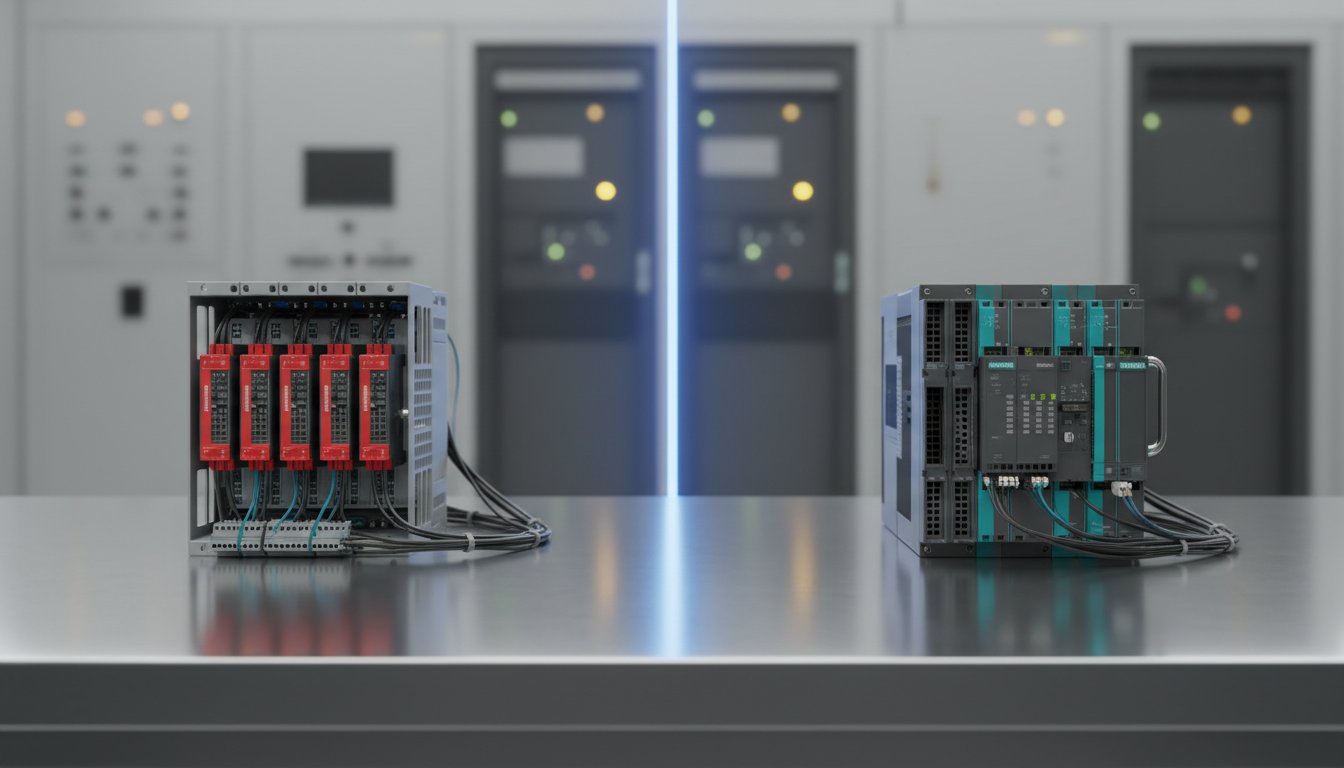
Stuck choosing a PLC? The AB Allen Bradley vs. Siemens debate is a major decision for any Australian project. Finding a straight, unbiased comparison is tough. You need real facts on everything from local hardware availability to the complexities of Studio 5000 versus TIA Portal, not just a sales pitch from a biased supplier. It’s a choice that directly impacts your project’s budget, efficiency, and long-term support network right here in Australia.
This is your direct, no-nonsense guide. We cut through the noise to give you a head-to-head breakdown of both ecosystems. We’ll compare the hardware, weigh the real-world pros and cons of the software, and look at the total cost of ownership for your operation. Get the clear information you need to make the right call for your specific application, your budget, and your team. No bias. Just the facts to help you choose and save.
Key Takeaways
- Learn the core difference: Allen-Bradley’s focus on ease-of-use versus Siemens’ integrated engineering power to match the right brand to your team’s skills.
- Discover why the software-Studio 5000 vs. TIA Portal-is often the most critical factor and biggest long-term cost for your Australian operation.
- Get a direct hardware comparison between the flagship AB Allen Bradley ControlLogix and Siemens SIMATIC S7 families, focusing on modularity and backplane design.
- Receive a simple framework to evaluate your specific project needs, from local support availability to total cost of ownership.
Allen-Bradley vs. Siemens: The Core Philosophies
In the world of industrial automation, Allen-Bradley and a key alternative consistently stand out. For Australian engineers and procurement managers, deciding between these major players is a critical choice that directly impacts project cost, development time, and long-term maintenance. While a competing platform holds a strong presence in some regions, the ab allen bradley platform is deeply entrenched across North America and Australia, influencing everything from local support to the availability of skilled technicians.
The decision often boils down to a fundamental difference in approach. At the heart of these systems is the Programmable Logic Controller (PLC), the industrial computer that automates machinery and processes. Allen-Bradley has built its reputation on straightforward usability and rapid troubleshooting, while its primary competitor champions a powerful, deeply integrated ecosystem. This guide provides a direct, no-nonsense comparison to help you select the right system for your project’s specific needs and budget.
Allen-Bradley: The Focus on Usability
Known for its extremely robust hardware and intuitive programming, the ab allen bradley platform is often the default choice for ease of use. Its programming environment, Studio 5000, is heavily based on ladder logic, a format that is familiar and easy for plant electricians and maintenance technicians to diagnose quickly on the factory floor. This strong legacy and brand recognition in Australian mining, food and beverage, and manufacturing means a deep talent pool and readily available parts.
The Integrated Ecosystem Approach
The core strength of this alternative lies in its comprehensive integrated automation platform. This single, powerful software environment seamlessly combines PLCs, HMIs, safety, and drives into one cohesive project. While the initial learning curve can be steeper, the payoff is immense for complex applications and large-scale systems. For projects demanding high-level process control, advanced diagnostics, and tightly integrated components from a single vendor, this platform offers unparalleled performance and engineering efficiency.
Hardware Deep Dive: ControlLogix vs. SIMATIC S7
When selecting a PLC, the physical hardware is your foundation. Both Allen-Bradley and Siemens offer scalable, modular systems, but their design philosophies differ. Matching the hardware to your application’s scale is critical for performance and cost-effectiveness.
Allen-Bradley Hardware Ecosystem
The ab allen bradley hardware range is known for its robust, chassis-based architecture, especially in larger systems. It provides clear scalability from small machines to entire plant-wide control.
- ControlLogix & GuardLogix: The flagship for high-performance, demanding applications. These controllers slot into a chassis (backplane) and offer extensive I/O module options, from basic digital I/O to advanced motion and process control.
- CompactLogix: A powerful, more compact controller for mid-range machine and system control. It offers much of the ControlLogix power in a smaller, often chassis-less form factor.
- Micro800 Series: Cost-effective controllers for smaller, standalone machines and simple automation tasks.
Siemens Hardware Ecosystem
Siemens hardware is built around efficiency and integrated communication. The SIMATIC family is renowned for its compact design and powerful built-in features, particularly its deep integration with the PROFINET industrial Ethernet standard.
- SIMATIC S7-1500: The high-performance flagship, replacing the older S7-300/400 series. It features an integrated display for diagnostics, powerful processing, and native PROFINET ports for high-speed communication.
- SIMATIC S7-1200: A versatile and compact controller ideal for a wide range of control tasks. It packs significant power into a small footprint.
- LOGO! Logic Modules: Designed for very simple automation tasks, replacing traditional relays and timers at a low cost.
Availability and Sourcing in Australia
In Australia, both brands are well-supported, but sourcing specific modules can sometimes lead to long lead times or high local prices through official channels. This is where a parallel import model provides a direct advantage. InstroDirect leverages a global supply network to source genuine ab allen bradley and Siemens hardware at lower prices, getting you the parts you need faster. Can’t find a specific module? Check our comprehensive shop.

Software Showdown: Studio 5000 vs. TIA Portal
Hardware is only half the battle. The programming software is where your engineers spend their time, and it’s often the single biggest factor in choosing a platform. This is a direct comparison of Rockwell’s Studio 5000 and Siemens’ TIA Portal-the two dominant environments in Australian industry.
Rockwell’s Studio 5000 Logix Designer
The software for the ab allen bradley ControlLogix and CompactLogix family is praised for its clean interface. Its ladder logic editor is an industry benchmark, feeling intuitive and efficient, especially for those familiar with older Rockwell platforms. A key advantage is its powerful online editing capability, allowing for live code changes without stopping the processor-a massive benefit for reducing plant downtime during commissioning or troubleshooting. The main drawback is version management; each version of Studio 5000 is tied to specific controller firmware. Licensing is also a major consideration. You buy separate packages for different tasks (PLC, HMI, etc.), and the upfront cost in Australia can be substantial, often running into thousands of AUD for a single license.
Siemens’ Totally Integrated Automation (TIA) Portal
Siemens offers a completely different philosophy. TIA Portal is a single, unified engineering framework for your entire system: PLCs, HMIs, SCADA, and drives. This “Totally Integrated” approach simplifies project management and data sharing between devices. Its built-in simulation tools are extremely powerful, allowing for comprehensive code testing without needing physical hardware. On the other hand, for a simple project, TIA Portal can feel complex and demands significant PC resources. Its licensing, however, is often more flexible. With options like floating licenses and tiered packages, it can present a more cost-effective solution, particularly for larger engineering teams or businesses running multiple projects.
Key Software Differences:
- Workflow: Studio 5000 offers a focused, best-in-class ladder logic experience. TIA Portal provides a unified, all-in-one project environment.
- Standout Feature: Rockwell’s online editing is superior for live systems. Siemens’ built-in simulation is a huge advantage for offline development.
- Licensing Costs (AUD): The ab allen bradley ecosystem typically has a higher upfront, per-package cost. Siemens often provides more flexible and potentially lower-cost licensing structures.
Key Decision Factors for Your Application
The spec sheets tell one story. Real-world project success tells another. Choosing between Siemens and an ab allen bradley PLC isn’t about which is ‘best’-it’s about which is right for your specific application, budget, and team. Use this practical framework to make the right call for your Australian operation.
Team Skillset and Training
What does your team already know? Sticking with a familiar platform saves significant time and training costs. While both brands have strong training resources available in Australia, Allen-Bradley’s Studio 5000 is often seen as having a faster learning curve for basic machine control tasks, getting technicians up to speed quickly. If your team is already proficient in one ecosystem, the cost to switch must be justified.
Project Requirements & Scalability
Define your project scope clearly. Is it a simple, standalone machine or a complex, plant-wide process requiring tight integration?
- Simple to Mid-Size Machines: Allen-Bradley often excels here with its straightforward Logix platform, making it a go-to for many machine builders.
- Large, Integrated Processes: Siemens often has the edge in large-scale applications, particularly in process control (e.g., chemical, water treatment) where its TIA Portal provides a powerful, unified environment for PLC, HMI, and drives.
Always consider future expansion. Ensure the platform you choose can scale efficiently as your operational needs grow.
Total Cost of Ownership (TCO)
Look beyond the initial hardware price. True cost includes software licenses, annual support fees, training, and potential downtime. These ongoing expenses can quickly overshadow any initial hardware savings from a local distributor.
A major way to control your costs is through procurement. Parallel importing allows you to source genuine, new hardware at significantly lower prices. This strategy dramatically reduces the TCO for either platform, making your budget go much further. You get the same quality equipment without the high distributor markup. Get competitive pricing on both brands in our online shop to see the real-world savings for your project.
Final Verdict: A Quick Comparison Table
Choosing between Allen-Bradley and Siemens isn’t about finding a universal winner. The right PLC depends entirely on your application, budget, and existing infrastructure. This final summary breaks down the key differences to help you make a fast, informed decision for your Australian project.
Comparison Summary: Allen-Bradley vs. Siemens
| Criterion | AB Allen-Bradley | Siemens | Quick Verdict |
|---|---|---|---|
| Ease of Use | Studio 5000 is widely regarded as intuitive, with a straightforward layout that’s quick to learn, especially for those familiar with Rockwell. | The TIA Portal has a steeper learning curve but offers immense power and a unified environment once mastered. | Winner: Allen-Bradley (for faster onboarding). |
| Software Integration | Strong integration within the Rockwell ecosystem, but connecting various components can sometimes require separate software packages. | The Totally Integrated Automation (TIA) Portal provides a seamless, all-in-one engineering platform for PLCs, HMIs, and drives. | Winner: Siemens (for unified systems). |
| Hardware Cost | Often positioned as a premium product in Australia, which can mean higher upfront hardware and licensing costs. | Generally offers a more competitive price point, especially on larger systems, providing excellent value for money. | Winner: Siemens (for budget-conscious projects). |
| Scalability | Excellent for scaling from small, standalone machines to large factory-wide automation systems. A top choice for discrete manufacturing. | A global leader in process control and highly complex, distributed systems. Its scalability is a key strength in large infrastructure. | Winner: Tie / Application-Dependent. |
Which One Should You Buy?
Your final choice comes down to your project’s specific demands. Use these guidelines as a starting point:
- Choose AB Allen-Bradley if: Your team is already trained on Rockwell software, you’re building standalone machinery, or your project specifications favour US-based standards common in many Australian mining and manufacturing sites.
- Choose Siemens if: Your project requires tight integration between all automation components, you’re focused on complex process control (e.g., water treatment, chemical), or you’re building equipment for export to Europe.
Ultimately, the best PLC is the one that aligns with your team’s skills and your operational goals. Whether you decide on the robust reliability of an ab allen bradley system or the integrated power of Siemens, getting the best price is crucial. InstroDirect leverages a global sourcing network to supply both brands at prices that beat traditional distributors in Australia.
Can’t find the specific PLC or I/O module you need? Contact our team directly. We source the parts you need at a price that fits your budget. Get a quote today and see how much you can save.
Making the Final Call: Allen-Bradley vs. Siemens
The debate between Allen-Bradley and Siemens ultimately comes down to your specific application, budget, and team expertise. Siemens excels with its highly integrated TIA Portal, making it a powerhouse for complex, process-driven projects. Conversely, the ab allen bradley ControlLogix platform is a dominant force in Australia, widely favoured for its user-friendly Studio 5000 software and robust performance in discrete manufacturing. The best choice hinges on whether you prioritise an all-in-one engineering environment or a more straightforward, modular approach your team is already familiar with.
Once you’ve made your decision, sourcing your components at the right price is the next critical step. At InstroDirect, we cut out the middleman. Our direct parallel importing model means you get amazing deals on the hardware you need. We hold extensive stock of both Allen-Bradley and Siemens PLCs, drives, and I/O modules, ensuring you can find the parts you’re looking for. If you’re still unsure, our expert support team is here to help you select the perfect components for your system’s requirements.
Equip your project for success and get the best prices on the world’s leading PLC brands today.
Shop our range of Allen-Bradley and Siemens PLCs now!
Frequently Asked Questions
Is Allen-Bradley the same as Rockwell Automation?
Yes. Allen-Bradley is the brand name for hardware components like PLCs, drives, and sensors. Rockwell Automation is the parent company that owns the Allen-Bradley brand. In the industry, the names are often used interchangeably. When you purchase an Allen-Bradley PLC, you are buying a product manufactured and supported by Rockwell Automation. It is their flagship hardware product line.
Which PLC is more popular in Australia, Allen-Bradley or Siemens?
In Australia, the AB Allen-Bradley brand has a larger and more established installed base, especially in the mining, manufacturing, and food and beverage industries. It is often the site standard for many facilities. While Siemens has a strong presence in process control and major infrastructure projects, you will generally find Allen-Bradley is more common across a wider range of Australian industrial applications.
Can I use Siemens software to program an Allen-Bradley PLC?
No, you cannot. PLC programming software is proprietary. To program an Allen-Bradley PLC, you must use Rockwell Automation’s Studio 5000 Logix Designer software. For Siemens PLCs, you must use their TIA Portal software. The hardware drivers, communication protocols, and programming environments are completely different and are not cross-compatible. You must use the correct software for your hardware.
What is the price difference between a comparable Allen-Bradley and Siemens PLC?
In Australia, Allen-Bradley PLCs and software licenses typically have a higher list price than comparable Siemens equipment. For a basic controller, the difference could be several hundred Australian dollars (A$). On larger, more complex systems, this price gap can extend into thousands. This is a key factor for many project managers and system integrators when specifying a new control system.
Which PLC is better for a beginner to learn on?
Many technicians find the AB Allen-Bradley platform and its Studio 5000 software more intuitive for beginners. The ladder logic programming is very straightforward and is widely taught in Australian TAFE courses. While Siemens TIA Portal is extremely powerful, its integrated nature can present a steeper learning curve. For getting started quickly with core PLC concepts, Allen-Bradley is often the recommended choice.
How does InstroDirect offer lower prices on genuine AB and Siemens parts?
InstroDirect operates on a parallel importing model. We source 100% genuine, new Allen-Bradley and Siemens products from official distributors in different global regions where pricing is more competitive. This allows us to bypass high local distributor markups and pass these significant savings directly to our Australian customers. You get the same authentic parts at a much lower price.
Leave a Comment
Your email address will not be published. Required fields are marked *