

Downtime is expensive, and choosing the wrong pressure sensor is a common cause. Are you uncertain about absolute vs. gauge pressure? Struggling to source reliable aps in Australia that won’t blow the budget? These delays cost time and money, impacting project deadlines and operational efficiency in harsh industrial environments.
These sensors are often integrated into larger pneumatic systems. For engineers sourcing other essential parts like valves, cylinders, and air preparation units, factory-direct suppliers such as VidoAir offer a comprehensive range of premium components for industrial automation.
This guide is built for engineers who need answers now. We cut straight to the point. Learn the critical differences between pressure sensor types. See exactly where they are used in demanding Australian industries, from mining to manufacturing. Most importantly, discover how to source the correct, durable models from reliable suppliers without paying inflated manufacturer RRP. Get the technical clarity you need to select the right part, find it in stock, and get your operation back online faster. Save time, save money, and eliminate the guesswork.
Key Takeaways
- Understand the core difference: Absolute Pressure Sensors (APS) measure against a perfect vacuum, crucial for applications unaffected by altitude or weather.
- Discover how APS drive efficiency and safety in key Australian sectors like mining, manufacturing, and food processing.
- Use our practical checklist to select the right sensor by matching specifications like pressure range and media compatibility to your exact application.
- Compare sourcing options to find the best deals on aps australia, weighing the pros and cons of authorised distributors versus parallel importers.
Decoding ‘APS’: What is an Absolute Pressure Sensor?
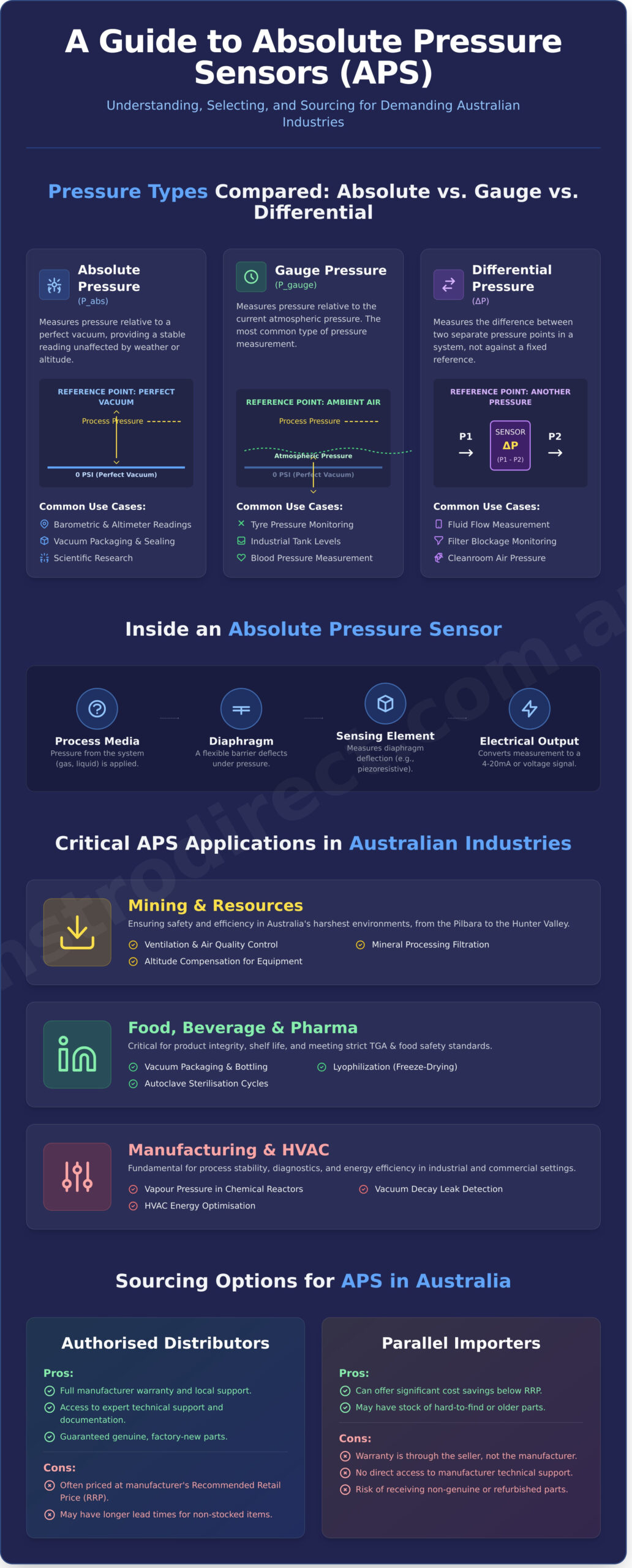
In the industrial automation market, ‘APS’ stands for Absolute Pressure Sensor. Its core function is to measure pressure relative to a perfect vacuum-a space with zero pressure. This provides a fixed, unchanging reference point for every measurement.
Why is this critical? Because it delivers readings that are completely unaffected by changes in atmospheric pressure. Think of it like this: a standard tyre gauge measures gauge pressure. It will show a different reading for the same tyre if you measure it at sea level versus on a high mountain. An Absolute Pressure Sensor, however, would give the same reading in both locations because its reference point is the constant of a perfect vacuum, not the fluctuating air pressure around it. For precision processes, this stability is essential.
Absolute vs. Gauge vs. Differential Pressure: A Clear Comparison
Choosing the correct sensor is vital for system accuracy and cost-efficiency. Understanding the three primary Pressure Sensor Types prevents sourcing errors. Each uses a different zero reference point.
- Absolute Pressure (P_abs):
- Reference Point: Perfect vacuum (0 PSI).
- Common Use Cases: Barometric measurement, vacuum packaging, aviation altimeters, and scientific research where atmospheric pressure must be excluded.
- Gauge Pressure (P_gauge):
- Reference Point: Current ambient atmospheric pressure.
- Common Use Cases: Tyre pressure, tank levels, and blood pressure monitoring. Most common pressure measurement type.
- Differential Pressure (ΔP):
- Reference Point: Another specific pressure point in the system.
- Common Use Cases: Measuring fluid flow across an orifice, monitoring filter blockages, and managing cleanroom air pressure.
The Technology Inside: How an APS Works
At the heart of an APS is a sealed reference chamber with a near-perfect vacuum. One side of a flexible diaphragm is exposed to this vacuum, while the other is exposed to the process media. As the process pressure changes, the diaphragm deflects. This movement is detected by a sensing element, often a piezoresistive strain gauge, which alters its electrical resistance. This change is then converted into a standardised electrical output-typically a 4-20mA or voltage signal-that a control system can read. When sourcing an aps australia for your facility, confirming this output signal is critical for compatibility.
Critical Applications of APS in Major Australian Industries
Absolute Pressure Sensors (APS) are not optional components; they are essential for control, safety, and efficiency across Australia’s core industries. An accurate APS reading directly impacts product quality, operational uptime, and profitability. For any business sourcing aps australia wide, understanding these applications is key to selecting the right part at the best price.
Mining and Resources
In the demanding environments of Australian mining, precision is non-negotiable. APS provide critical data for:
- Ventilation Control: Barometric pressure readings are vital for managing air quality and ensuring worker safety in underground mines.
- Mineral Processing: Monitoring vacuum pressures in filtration systems ensures maximum resource extraction and operational efficiency.
- Altitude Compensation: For equipment operating at varying elevations, from the Pilbara to the Hunter Valley, APS provide a stable reference point for accurate process control.
Food, Beverage, and Pharmaceutical
These highly regulated industries rely on APS for product integrity, safety, and compliance. Key processes include:
- Vacuum Packaging: Ensuring correct vacuum levels in bottling lines and food packaging guarantees freshness and extends shelf life, meeting strict food safety standards.
- Lyophilization (Freeze-Drying): In pharmaceutical manufacturing, precise vacuum control is critical for preserving sensitive biological products.
- Sterilisation: Monitoring pressure inside autoclaves confirms that sterilisation cycles meet TGA standards for medical and lab equipment.
Manufacturing and HVAC
From chemical plants to commercial buildings, APS are fundamental to process control and system diagnostics.
- Chemical Processing: Accurately measuring vapour pressure to maintain stable and safe conditions during sensitive reactions.
- Leak Detection: Using vacuum decay methods to quickly identify leaks in sealed systems, preventing product loss and costly downtime.
- HVAC Performance: Integrating barometric pressure data with building management systems optimises energy efficiency. In fact, weather prediction is one of the key applications of absolute pressure sensors, allowing HVAC systems to adjust proactively.
Getting the right sensor for these critical tasks is vital. Sourcing through parallel importing gives you access to genuine parts without the high markups. See our range of industrial automation components suitable for these applications.
How to Select the Right Absolute Pressure Sensor: A Checklist
Choosing the correct absolute pressure sensor (APS) is a balancing act. Over-specifying means you pay for precision you don’t need. Under-specifying risks inaccurate data, process failure, and costly downtime. This practical checklist is designed for engineers and procurement managers to define exact requirements, ensuring you get the right performance at the best price.
Key Performance Specifications to Check
Matching the sensor’s technical data to your application is the first step. Get these four points right to avoid compatibility issues and unnecessary expense.
- Pressure Range: Your normal operating pressure should fall comfortably within the sensor’s calibrated range. Don’t pay for a 100 bar sensor if your process never exceeds 10 bar.
- Accuracy and Linearity: How precise does your measurement need to be? A sensor with 0.5% accuracy is significantly cheaper than one with 0.1% accuracy. Only pay for the precision your system requires.
- Output Signal: Ensure the sensor’s output (e.g., 4-20mA, 0-10V, HART protocol) is directly compatible with your PLC, controller, or data acquisition system to prevent integration problems.
- Process Connection: Verify the thread type (e.g., BSP, NPT) and size match your existing pipework or vessel. The wrong connection causes installation delays and requires costly adapters.
Environmental and Material Compatibility
A sensor must be tough enough to survive its operating environment. Mismatched materials or inadequate protection leads to premature failure.
- Wetted Materials: The sensor components touching the process fluid must be chemically compatible. While 316L Stainless Steel is a common choice, corrosive media may require materials like Hastelloy C.
- Operating Temperature: Confirm the sensor can handle the full range of your process and ambient temperatures without losing accuracy.
- IP Rating: The Ingress Protection rating (e.g., IP67) indicates the level of sealing against dust and water. A higher rating is essential for outdoor or wash-down environments.
- Hazardous Area Certifications (IECEx): For use in potentially explosive atmospheres, an IECEx certification is a mandatory safety requirement in Australia. Sourcing a compliant aps australia model is non-negotiable.
Leading Brands and Models
InstroDirect provides access to top-tier instrumentation from world-leading brands like Endress+Hauser, WIKA, and Vega. Through our parallel importing model, we source the exact same high-quality sensors you know and trust, but without the high local RRP set by authorised distributors. You get the performance and reliability of a premium brand at a much lower cost.
Need a specific model or can’t find what you’re looking for? Browse our full catalogue online or contact our team directly for a quote.
Sourcing APS in Australia: Authorised Distributors vs. Parallel Importers
When you need to purchase an APS (Absolute Pressure Sensor) in Australia, you have two primary channels. Understanding the difference is key to getting the best value for your project while meeting your company’s procurement requirements.
The Authorised Distributor Model
This is the traditional, manufacturer-approved supply chain. The distributor has a direct relationship with the brand, acting as their official local agent. This channel is often preferred by large organisations with rigid purchasing policies.
- Pros: Direct manufacturer warranty and support, often have local stock for common parts, and an official sales channel that satisfies strict corporate procurement policies.
- Cons: Prices are typically set at the Manufacturer’s Recommended Retail Price (RRP), leading to significantly higher costs in A$. Sales processes can be rigid and less flexible.
Best for: Large corporations or government bodies with strict procurement rules that mandate purchasing only through authorised channels.
The Parallel Import Model (InstroDirect’s Approach)
Parallel importing is a smarter way to source industrial parts. We bypass the high local RRP by sourcing 100% genuine, new products from official distributors in other global markets where prices are lower. We then import them directly to Australia, passing the savings on to you.
- Pros: MASSIVE cost savings-often over 40% OFF RRP. Access to a wider global inventory, making it easier to find hard-to-get or long-lead-time parts.
- Cons: We are not an ‘authorised’ Australian distributor. Your warranty is held and serviced directly by InstroDirect, not the original manufacturer.
Best for: Price-conscious businesses, system integrators, and engineering teams looking for the best deal on genuine aps australia sensors without compromising on quality.
Why Choose InstroDirect for Your Sensor Needs?
InstroDirect delivers the best of both worlds: unbeatable pricing on genuine parts backed by local expertise. We are your direct line to a global supply network, ensuring you get the exact component you need, fast.
Our model is simple: we find authentic aps australia parts at the best possible price globally and pass those savings directly to you. All products are new, in their original packaging, and sourced from reputable channels. Your purchase is supported by our expert, Australian-based team who understand your technical requirements.
Can’t find the specific pressure sensor you’re looking for on our site? Don’t worry. Our core business is sourcing hard-to-find components. Contact us directly with your part number for a competitive, no-obligation quote and see how much you can save.
Your Source for Absolute Pressure Sensors in Australia
Selecting the correct absolute pressure sensor is crucial for operational accuracy and safety across Australia’s demanding industries. As this guide has shown, understanding the core technology, following a detailed selection checklist, and knowing your sourcing options are key to success. When sourcing aps australia, you need a supplier that offers both technical expertise and significant cost savings.
InstroDirect is your direct source for genuine, new components from leading global brands. Benefit from expert Australian-based support and advice while you save over 40% from manufacturer RRP. We cut out the middleman to deliver the best prices directly to you.
Can’t find the sensor you’re looking for? Contact us directly for pricing! Get the right part, at the right price, right now.
Frequently Asked Questions
What is the main difference between an absolute pressure sensor and a barometer?
An absolute pressure sensor (APS) measures pressure relative to a perfect vacuum sealed inside the sensor, providing a fixed, unchanging reference point for industrial processes. A barometer specifically measures the local atmospheric pressure for weather or altitude purposes. While both measure absolute pressure, an APS is built for precise process control, whereas a barometer is designed for environmental monitoring. They are not interchangeable for most industrial applications.
Can I use a gauge pressure sensor for a vacuum measurement application?
No, a standard gauge pressure sensor is unsuitable for accurate vacuum measurement. Gauge sensors measure pressure relative to the current atmospheric pressure, not a true zero. For proper vacuum applications, you must use an absolute pressure sensor or a dedicated compound pressure sensor. These instruments are specifically engineered to accurately measure pressures below the local atmospheric pressure, providing the reliable data needed for vacuum control.
How often do industrial absolute pressure sensors need to be calibrated?
Calibration frequency depends entirely on the application’s criticality and operating environment. For critical processes, calibration every 6 to 12 months is standard practice. For less demanding systems, a 1 to 2-year interval may be sufficient. Always check the manufacturer’s recommendations first. Factors like high vibration, extreme temperatures, or corrosive media will require more frequent checks to ensure continued accuracy and safety.
What are the most common reasons for an APS to fail in the field?
The most common reasons for an APS to fail are overpressure events that exceed the sensor’s specified range and cause diaphragm damage. Other major factors include severe vibration, extreme process temperatures, and chemical corrosion from incompatible media. For many an APS Australia operating in harsh sites, simple issues like incorrect installation or clogging of the pressure port with process debris can also lead to inaccurate readings or complete failure.
Are the sensors from parallel importers like InstroDirect genuine?
Yes, products sourced through parallel importing are 100% genuine. We procure authentic, factory-sealed sensors from a global network of suppliers, bypassing the high markups of official local distributors. This is how parallel importing saves you significant money. You receive the exact same high-quality product from leading brands; the only difference is a more direct and cost-effective supply chain that delivers better prices directly to you.
Which brands are considered leaders in pressure measurement technology?
Several brands are globally recognised for leadership in pressure measurement. Industry titans include Emerson (with their Rosemount line), Yokogawa, Siemens, and Endress+Hauser. These manufacturers are known for producing highly accurate, reliable, and durable pressure sensors and transmitters suited for a wide range of demanding industrial applications. We source these top-tier brands to provide you with the best technology at lower prices.


Leave a Comment
Your email address will not be published. Required fields are marked *