
Your Guide to Allen-Bradley PLCs in Australia: Models, Pricing & Availability
Stop waiting for official distributors. Tired of long lead times and high RRP on essential automation parts in Australia? Finding the right allen…

Stop waiting for official distributors. Tired of long lead times and high RRP on essential automation parts in Australia? Finding the right allen…
Machine down and project budget blown? Waiting weeks for a critical part from an official distributor is a major frustration for Australian…
Production stopped? Facing huge markups on Rockwell parts from official distributors in Australia? Sourcing Allen-Bradley PLCs and drives shouldn’t…
Stop guessing on circuit breaker sizes. Stop wasting time decoding complex spec sheets for your PowerFlex drives. In any industrial setting, getting…
Tired of paying premium prices for genuine Phoenix Contact components in Australia? Navigating the massive official catalog is overwhelming, and…
The Pool Pump Paradox: Power Reduction vs. Flow Rate
Let’s start with a common example: your pool pump. Many modern pool pumps come with VFDs, promising significant power savings. You see a drastic drop in power consumption when you run the pump at a lower speed—say, half the power. Sounds great, right?
But here’s the catch: the relationship between motor speed (and power) and the resulting flow rate is not linear, thanks to the affinity laws.
If you only use half the power, you might only be pumping one-third of the water volume.
If your goal is to cycle the entire pool volume twice a day for proper sanitation, a reduced flow rate means the pump has to run for a much longer time.
Imagine: at full power, you pump 30,000 L/hour. In “power-saving mode,” you only pump 3,000 L/hour. If your pool volume requires 8 hours of pumping at full speed to cycle, it will now take 80 hours at the lower speed!
Over the course of a day, you might actually use more total energy running the pump for an excessive duration at low efficiency than running it flat-out for the necessary shorter period.
💡 The Takeaway: Simply looking at the instantaneous reduction in power is misleading. You must look at the pump’s specifications and its efficiency curve versus the required volume (flow rate). If the lower speed pushes the pump far outside its most efficient operating band, or if the time needed to meet the demand becomes excessive, the “savings” vanish.
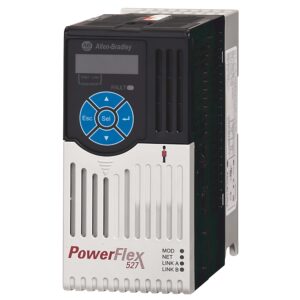
PowerFlex527 Australia
🏗️ Industrial Applications: Where VFDs Truly Shine
While a VFD on a residential pump needs careful balancing, their value in large-scale industrial or municipal applications is undeniable. This is where the core benefit of matching supply to demand becomes critical.
Consider a large potable water pump station with a 3 MW motor.
Without a VFD: The pump runs at 100% power, generating 100% flow, even if only 20% flow is needed. This is massive waste.
With a VFD: The VFD allows the pump speed to be precisely matched to the current need—say, a slow trickle-in or matching the demand of the city in real-time. This saves significant power over the pump’s run time. Just quickly a flow meter gives the feed back on the cities demand so the pump is only giving what the city needs.
Ramp up replenishment during off-peak or cheap hours (when the grid has spare, less expensive power) and slow down during peak times.
Maintain necessary residual pressure and flow without over-pumping.
Starting a massive, MW-style electric motor “across the line” (full power immediately) creates a huge inrush current spike that can easily break this demand threshold.
A VFD acts as a soft starter. It gradually ramps up the motor’s speed and current draw, keeping the initial demand well below the threshold, thus saving the customer from incurring significant financial penalties for demand surplus. Its called Peak power demand is charged as the utilities measure the draw and charge hefty so the good ole vfd can stop or reduce those charges peak demands.
The Key is Matching Demand
VFDs are an incredible tool, but their efficiency hinges on matching the output to the actual, variable process requirement.
It’s NOT always efficient: If the process is constant demand (like a continuously running conveyor belt) or if the motor operates inefficiently at low speed (like our pool pump example), the VFD itself adds a small layer of inefficiency (due to internal power electronics). With a conveyor if you not exceeding the friction and the inertia on a set speed you can load the motors and the vsd in non ideal conditions and cause more issues on straining the gear to do the job.
It IS highly efficient: When the required flow, pressure, or speed changes frequently, the VFD becomes the essential element for saving energy by allowing the motor to run at the precise speed needed.
VFDs save power by reducing the amount of work done, which is only a net saving if that reduction in work still meets the overall process requirement in a timely and efficient manner.
The topic does not only apply to pumps but fan speed which is also a great use case of VSDS as you only spin hard on bad air conditions id the air is good you can wind down the rpm as your air quality is good between 1am and 4 am and the savings may be 18% per day in power costs so all these tweaks add up.
If you need a vsd call us at www.instrodirect we have all the drives you need to get automated.