
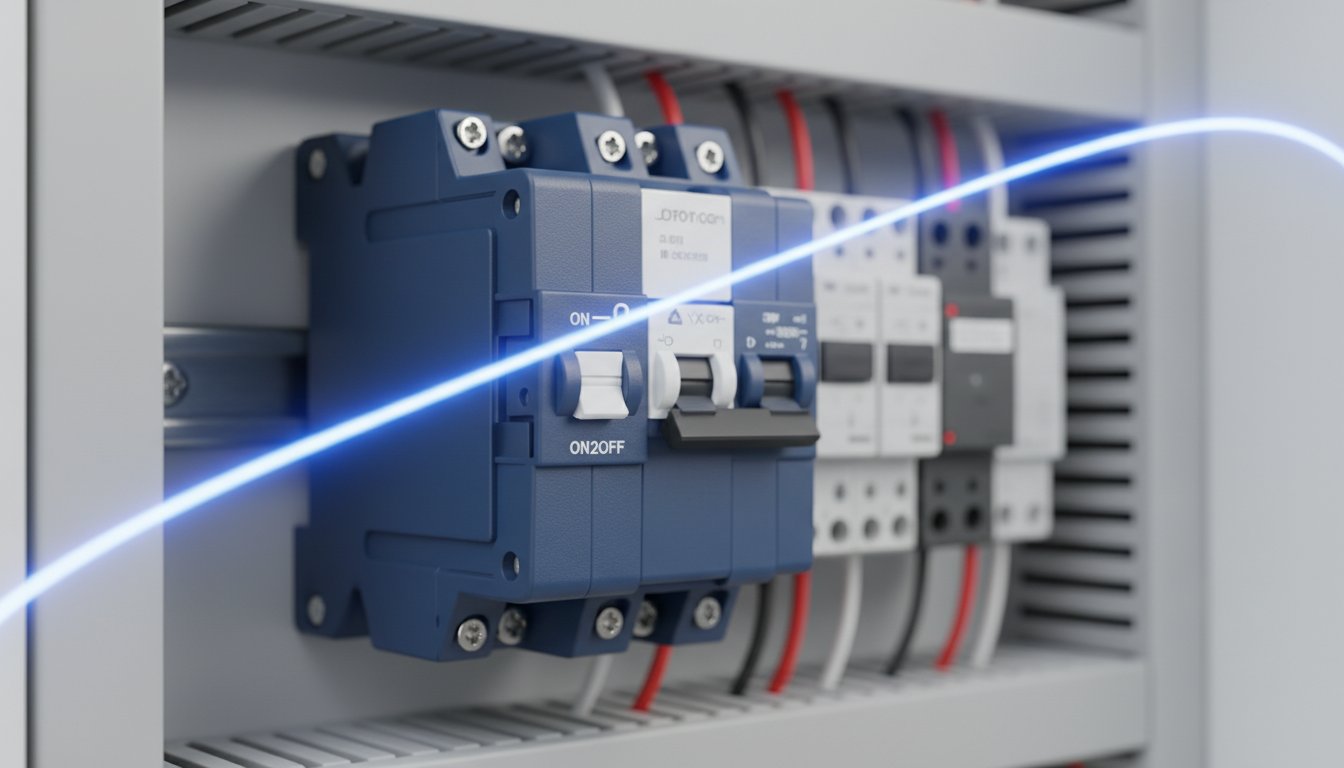
Choosing the wrong circuit breaker for an industrial motor or machine isn’t just a mistake-it’s a recipe for costly downtime, equipment damage, or even a fire. If you’re confused by technical jargon like ‘kA rating’ or which ‘trip curve’ you need, you’re not alone. Selecting the wrong part means unacceptable risk and wasted money.
This guide cuts straight to the point. Get the essential information you need, fast. We cover exactly what a circuit breaker is, how to decode its specifications, and the critical steps to select the right one for your industrial equipment. No fluff, just the facts to ensure safety, compliance, and reliability for your Australian operations.
Learn the essentials to confidently choose the correct protective device every time. Prevent expensive failures and find a reliable local source for top-brand industrial breakers at the best prices. Get the right part, first time, and keep your facility running without interruption.
Key Takeaways
- Understand the core function of a circuit breaker to prevent costly equipment damage from overloads and short circuits.
- Learn to decode critical safety ratings like voltage, amperage, and interrupting capacity to ensure compliance and safety.
- Identify common industrial breaker types (MCB, MCCB, RCD) and know their specific applications to avoid mis-selection.
- Follow a simple 4-step process to select the correct industrial circuit breaker for your specific application, ensuring system reliability.
What is a Circuit Breaker and Why is it Non-Negotiable in Industry?
At its core, a circuit breaker is an automatic electrical switch. Its job is simple but critical: protect an electrical circuit from damage caused by excess current. For a deep dive into the fundamentals, you can explore what is a circuit breaker? on a technical level. Unlike a single-use fuse that must be replaced-costing time and money-a circuit breaker can be reset manually or automatically. This reusability offers superior, more precise protection and immediate operational advantages.
In any Australian industrial setting, this device is non-negotiable. It is the frontline defence for high-value assets. Think of the cost to replace a damaged variable speed drive (VSD), a motor, or a complex Programmable Logic Controller (PLC). A correctly specified breaker prevents catastrophic failures from overloads and short circuits, safeguarding equipment that can cost tens of thousands of dollars. This directly translates to maximised machinery uptime and, most importantly, enhanced personnel safety, a mandatory requirement for any modern worksite.
How a Circuit Breaker Works: The Core Mechanism
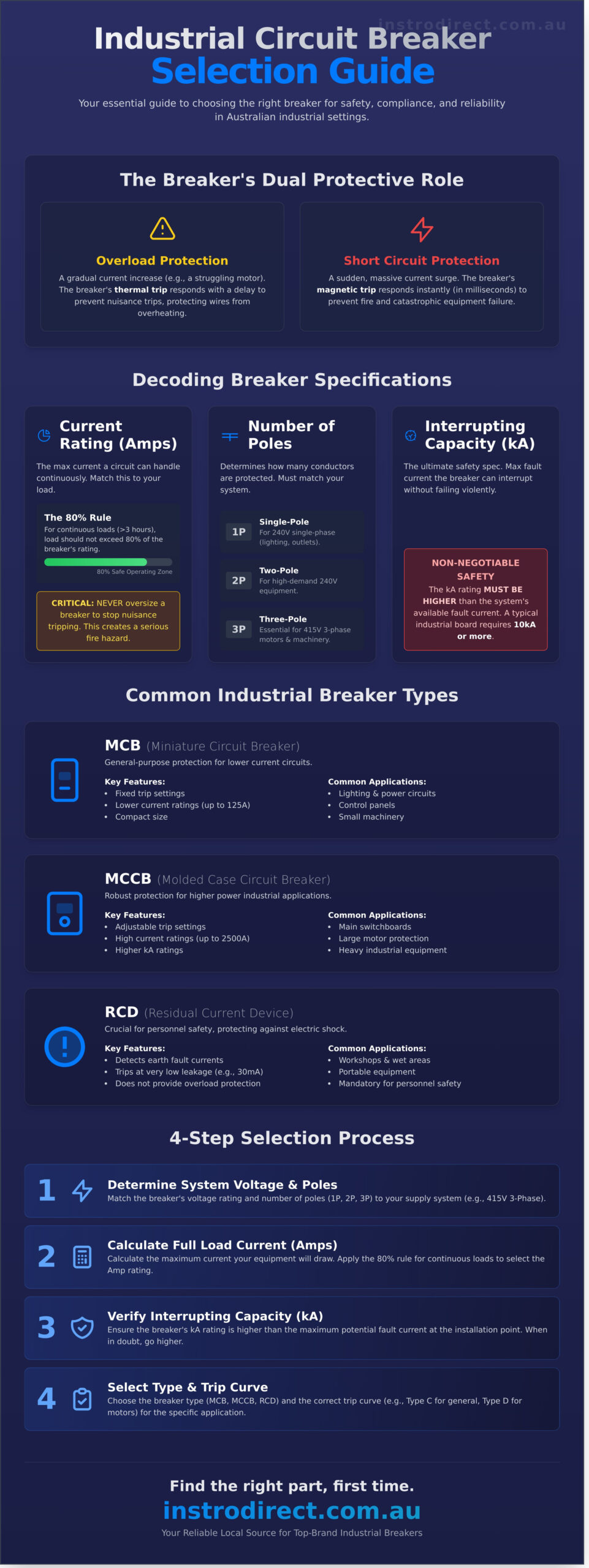
A standard thermal-magnetic circuit breaker uses a dual mechanism to detect faults. This ensures a fast and appropriate response to different electrical dangers:
- Thermal Protection (Bimetallic Strip): For overloads, a bimetallic strip heats up and bends, tripping a switch to break the circuit. This has a built-in delay to avoid nuisance tripping from temporary in-rush currents.
- Magnetic Protection (Electromagnet): For short circuits, a sudden, massive current surge creates a strong magnetic field in a solenoid coil, which instantly trips the switch.
- Arc Chute: When the contacts separate, an electrical arc forms. The arc chute safely contains and extinguishes this arc, preventing fire and damage.
Overload vs. Short Circuit: Two Dangers, One Solution
Understanding the two main electrical faults is key to appreciating a breaker’s function. An overload is a gradual increase in current beyond the circuit’s rated capacity, often caused by a struggling motor or too many devices on one line. The breaker’s thermal trip is designed to handle this. In contrast, a short circuit is a dangerous and immediate surge of current, often thousands of times the normal level. The breaker’s magnetic trip responds instantly to this threat, cutting power in milliseconds to prevent catastrophic failure and potential fire.
Decoding Circuit Breaker Specifications: A Technician’s Cheat Sheet
The numbers printed on any industrial circuit breaker are not suggestions. They are hard-wired limits-critical safety parameters that protect your equipment, your facility, and your team. Selecting the right industrial circuit breaker means matching its specifications directly to the application’s demands. Getting this wrong leads to equipment failure, fire, or catastrophic system damage. This cheat sheet breaks down the essentials.
Current Rating (Amps): Matching the Breaker to the Load
This is the maximum current a circuit can handle continuously without tripping. For industrial settings with continuous loads (running over three hours), the standard is the 80% rule: the load should not exceed 80% of the breaker’s rating. NEVER oversize a breaker to stop nuisance tripping. This defeats its protective purpose and creates a serious fire hazard by allowing wires to dangerously overheat.
Number of Poles (1P, 2P, 3P): Sizing for Your Circuit
The number of poles determines how many energised conductors the breaker protects. Matching the poles to your system is fundamental for correct operation and safety.
- Single-Pole (1P): For standard 240V single-phase circuits, protecting one “hot” wire. Common for lighting and general power outlets.
- Two-Pole (2P): Protects two conductors. Used for high-demand single-phase 240V equipment or specific control circuits.
- Three-Pole (3P): Essential for 415V three-phase equipment like industrial motors, pumps, and machinery, as it disconnects all three phases at once during a fault.
Interrupting Capacity (kA Rating): The Ultimate Safety Spec
The kA rating, or Ampere Interrupting Capacity (AIC), is the ultimate safety specification. It defines the maximum fault current (like from a dead short) the breaker can safely interrupt without exploding. This is non-negotiable. If a short circuit generates a current higher than the breaker’s kA rating, the device itself can fail violently. As detailed in global safety standards like the OSHA regulations for overcurrent protection, the interrupting rating must be higher than the system’s available fault current. For most Australian industrial switchboards, a rating of 10kA or higher is standard.
Quick Reference: Key Breaker Ratings
| Specification | What It Means | Why It Matters |
|---|---|---|
| Current Rating (A) | Max continuous current allowed. | Prevents wire overheating and fire. Must match wire gauge. |
| Number of Poles (P) | Number of protected conductors. | Matches the electrical system (e.g., 1P for 240V, 3P for 415V). |
| Interrupting Capacity (kA) | Max fault current it can safely stop. | Prevents breaker explosion during a major short circuit. |
Common Types of Industrial Circuit Breakers and Their Uses
Selecting the right circuit breaker means matching the device to the specific job. In industrial environments, different types of breakers protect everything from sensitive control systems to high-power machinery. Understanding the common acronyms-MCB, MCCB, RCD, and RCBO-is the first step to specifying the correct protection for your facility.
Miniature Circuit Breakers (MCBs): For Control Circuits & Final Sub-Circuits
MCBs are the most common type of circuit breaker found inside control panels and final distribution boards. They are designed for lower current applications and are typically DIN rail mounted for quick and easy installation. Their primary role is to protect specific final sub-circuits from overload and short circuits.
- Typical Uses: Protecting PLC I/O, control power transformers, lighting circuits, and small motor loads.
- Current Ratings: Generally available from 1A up to 63A, with some models extending to 125A.
- Location: Standard in control cabinets, automation panels, and light commercial switchboards.
Need MCBs for your next panel build? See our range of MCBs in our online shop. Get amazing deals on leading brands.
Moulded Case Circuit Breakers (MCCBs): For Main Feeders & Motors
When you need to protect high-current circuits, an MCCB is the solution. These are robust, heavy-duty breakers used as main incomers for switchboards or to protect large motors and feeder cables. Many MCCBs feature adjustable trip settings, allowing you to fine-tune protection for specific loads. Their rugged construction is designed to meet rigorous industrial specifications, such as the IEEE Standards for circuit breakers, ensuring reliable performance under demanding conditions.
RCDs and RCBOs: Protecting Personnel from Electric Shock
While MCBs and MCCBs protect equipment, RCDs and RCBOs protect people. Their job is not to detect overcurrent but to detect small earth leakage currents-the kind that can cause a fatal electric shock. Under Australian standards (AS/NZS 3000), this type of protection is mandatory for all final sub-circuits for socket outlets.
- RCD (Residual Current Device): Provides earth leakage protection only. It must be paired with a separate MCB for overcurrent and short-circuit protection.
- RCBO (Residual Current Breaker with Overcurrent): An all-in-one device combining the functions of an RCD and an MCB. It saves valuable space in the switchboard and simplifies installation.
How to Select the Right Industrial Circuit Breaker in 4 Steps
Choosing the correct industrial circuit breaker ensures safety, protects expensive equipment, and prevents unnecessary downtime. This straightforward 4-step process cuts through the complexity, providing a clear framework for engineers and technicians to select the right device for any application. Follow these steps to make a confident and correct choice.
Step 1: Define Your Circuit’s Voltage, Phase, and Load
Before looking at any product, you must define the electrical environment. These fundamental parameters dictate the baseline specifications for your breaker. Get these wrong, and the device will fail to protect your circuit effectively.
- System Voltage: Identify the nominal voltage of the system. Is it a 240V single-phase circuit or a 415V three-phase system?
- Phase Requirement: Confirm if you need a single-pole (1P) or three-pole (3P) breaker to match the circuit.
- Full Load Amps (FLA): Calculate the maximum current the load (e.g., a motor or machine) will draw under normal operating conditions. The breaker’s amp rating must be sized according to this value and local wiring rules.
Step 2: Choose the Correct Trip Curve for the Load Type
The trip curve determines how quickly a breaker reacts to an overcurrent. Selecting the wrong curve can lead to nuisance tripping on startup or, far worse, a failure to protect equipment. The most common industrial types are:
- Type C: Your general-purpose choice. Ideal for most commercial and industrial applications with moderate inrush currents, such as lighting circuits and resistive loads.
- Type D: The heavy-duty option. Designed for circuits with very high inrush currents, like large motors, transformers, and welding equipment.
- Other specialised curves like Type B (sensitive domestic), K (motors and transformers), and Z (highly sensitive electronics) exist for specific use cases.
Step 3: Determine the Required Interrupting Capacity (kA)
Interrupting Capacity, or fault rating, is a critical safety specification. It defines the maximum prospective short circuit current (PSCC) that a circuit breaker can safely interrupt without catastrophic failure. For large industrial sites, this value must be calculated by a qualified engineer. As a general rule, a minimum rating of 10kA is a safe starting point for most industrial sub-boards in Australia.
Step 4: Choose a Trusted Brand and Form Factor
With your technical specs defined, the final step is selecting the physical hardware. Reliability is non-negotiable. Choose globally trusted brands like Schneider Electric or Siemens to ensure performance and longevity. Confirm the physical mounting type-most modern Miniature Circuit Breakers (MCBs) use a standard DIN rail mount. Finally, always verify that your chosen device complies with all relevant Australian standards (AS/NZS). Shop for trusted circuit breaker brands for your next project and get the job done right.
Secure Your Operations with the Right Circuit Breaker
Ultimately, a circuit breaker is more than a component; it’s the frontline defence for your entire industrial operation. As we’ve covered, correctly decoding specifications, understanding the different types, and following a clear selection process are non-negotiable steps. This knowledge protects your valuable equipment from overcurrents, prevents costly downtime, and, most importantly, ensures the safety of your personnel. Making an informed choice is a direct investment in your facility’s reliability and long-term productivity.
When it’s time to source that critical component, InstroDirect has you covered. We provide direct access to major industrial brands like Schneider Electric, Siemens, and Rockwell. Our direct import model ensures you get competitive pricing to meet your budget, bypassing traditional markups. If you’re facing a complex application or can’t find a specific part, our expert technical support is ready by phone to provide a solution. Can’t find the right breaker? Contact our experts for direct assistance. Get the right part, at the right price, and power your operations with confidence.
Frequently Asked Questions
What is the difference between a circuit breaker and an RCD?
A circuit breaker protects equipment. Its job is to interrupt overcurrents from overloads or short circuits, preventing wires from overheating and causing a fire. An RCD (Residual Current Device) protects people from electric shock by detecting small imbalances in current flow, known as earth faults. For complete protection, these two functions are often combined into a single device called an RCBO.
Can I replace a circuit breaker with one that has a higher amp rating?
No. Never replace a circuit breaker with a higher amp rating. The rating is specifically matched to the wire gauge of the circuit it protects. Installing a breaker with a higher rating allows too much current to pass through the wiring, creating a severe fire hazard before the device can trip. Always use the correct, specified rating to comply with Australian electrical standards.
What do the trip curves (e.g., Type C, Type D) on a circuit breaker mean?
Trip curves define how quickly the breaker trips in response to different levels of overcurrent. Type C is a general-purpose curve for commercial and industrial applications with moderate inrush currents, like lighting and small motors. Type D is designed for equipment with very high inrush currents, such as large transformers, X-ray machines, and heavy-duty motors, to prevent nuisance tripping on startup.
How often should industrial circuit breakers be tested or replaced?
Testing frequency depends on the operational environment and manufacturer guidelines. For critical industrial settings in Australia, annual testing is a common practice to ensure reliability and safety compliance. Replacement isn’t on a fixed schedule; it’s determined by test results, the number of fault trips, age, or visible signs of wear and tear. Proactive maintenance prevents costly, unplanned downtime.
What is the kA rating on a circuit breaker and why is it so important?
The kA rating, or breaking capacity, is the maximum short-circuit fault current a breaker can safely interrupt without catastrophic failure. This is a critical safety rating. The installed breaker’s kA rating must be higher than the prospective short circuit current (PSCC) available at that point in the system. Using a device with an insufficient kA rating is a serious safety risk and code violation.
Are circuit breakers from brands like Schneider Electric worth the extra cost?
Yes. Investing in a premium brand like Schneider Electric is a sound decision for industrial and commercial applications. While the initial A$ cost is higher, you are paying for superior reliability, proven performance, and guaranteed compliance with stringent Australian standards. This long-term dependability protects valuable assets, ensures personnel safety, and reduces the significant costs associated with system downtime and maintenance.


Leave a Comment
Your email address will not be published. Required fields are marked *