
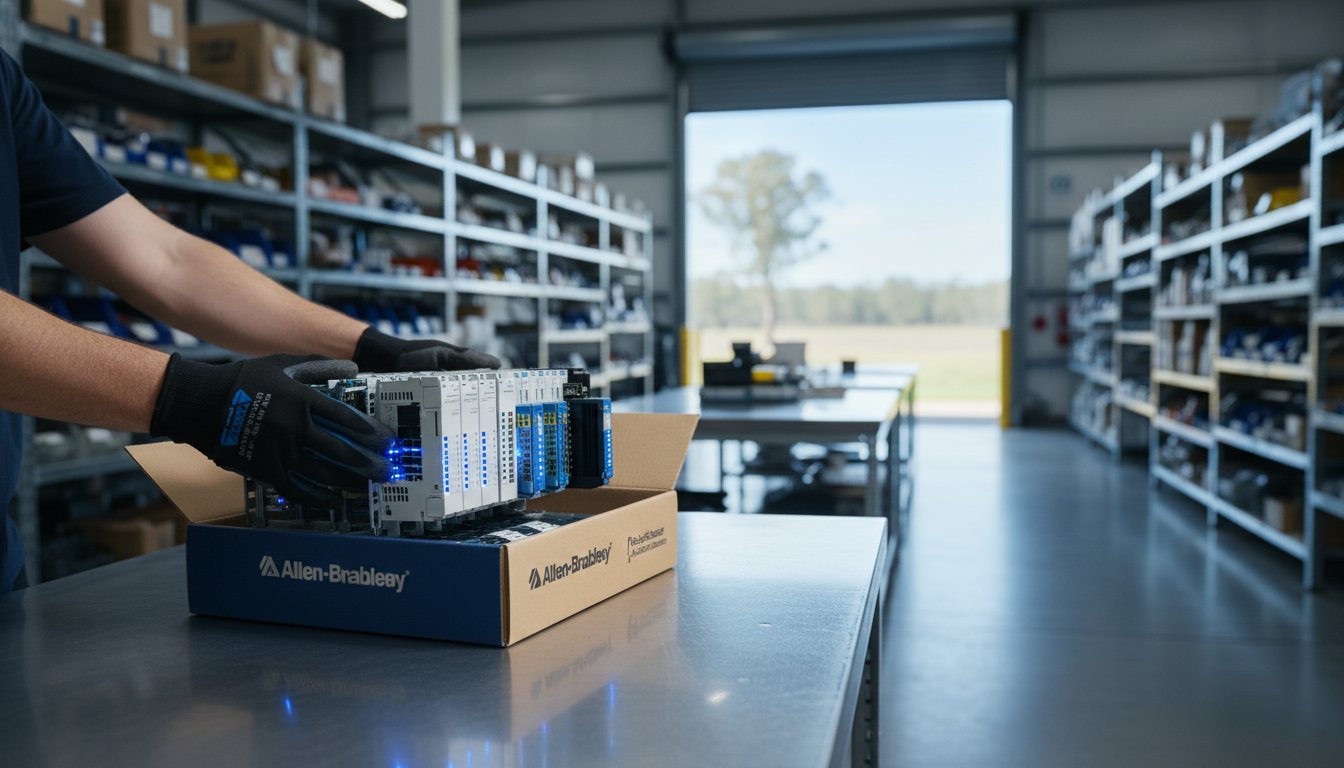
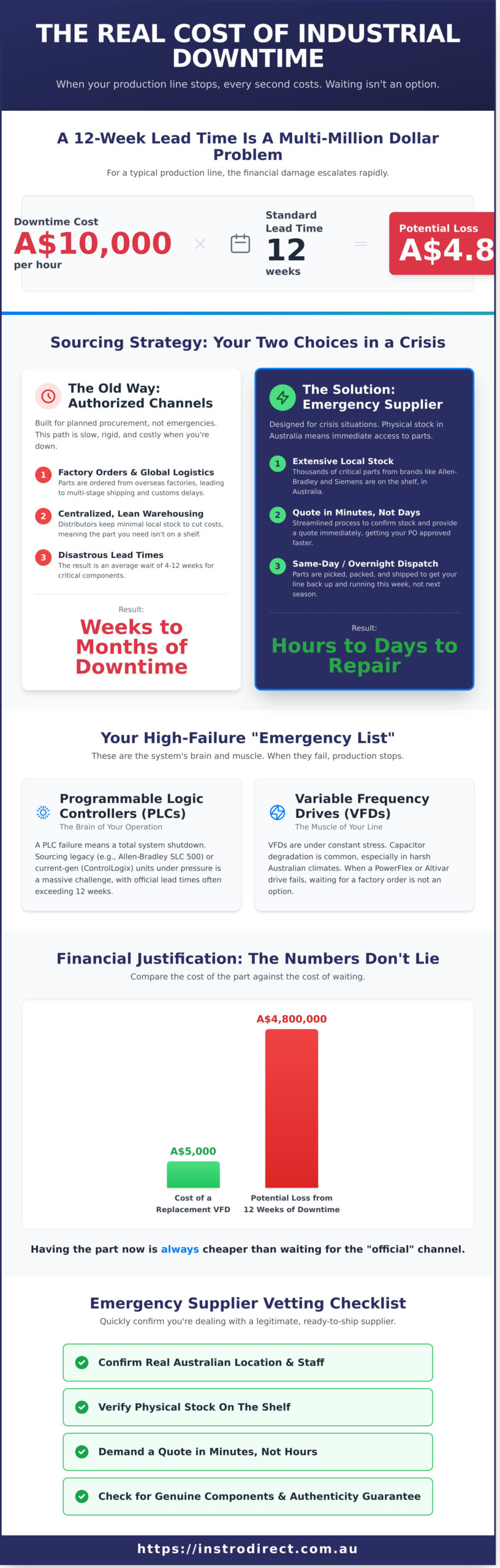
That 12-week lead time from your authorised distributor isn’t just an inconvenience. For a production line losing A$10,000 an hour, it’s a potential A$4.8 million problem. We know the feeling. Your line is down, the pressure is on, and the only answer you get is a delivery date sometime next quarter for that critical Allen-Bradley PLC or Siemens VFD.
Forget the standard process; it’s broken. You need an emergency industrial parts supplier with physical stock on the shelf, right here in Australia. This guide cuts through the delays, showing you exactly how to source genuine components for same-day dispatch and why having the part now is always cheaper than waiting for the “official” channel. We’ll cover how to get a quote in minutes, confirm authenticity, and get your operation back online this week, not next season.
Key Takeaways
- Learn how to calculate the real cost of downtime in AUD to justify your critical spares budget.
- Identify the most critical automation parts, like PLCs and VFDs, that are likely to fail and halt production.
- Discover why an emergency industrial parts supplier with parts on the shelf beats waiting on authorized dealer lead times.
- Get a simple checklist to quickly vet any supplier and confirm they have a real Australian location and staff.
The Reality of Industrial Downtime in 2026
An industrial emergency isn’t a fire or a flood. It’s a single, critical component failure. A burnt-out VFD on your main conveyor. A failed PLC processor that brings your entire packaging line to a halt. One faulty sensor stops tens of thousands of dollars in production. In modern manufacturing, where efficiency is everything, this is the crisis that costs millions.
The problem is amplified by lean production models. “Just-in-time” inventory looks great on a balance sheet until a ten-year-old Allen-Bradley drive fails. Suddenly, your streamlined operation has zero buffer. The part you need isn’t on a shelf in the warehouse; it’s weeks away in a distributor’s catalogue. This is the precise gap where an emergency industrial parts supplier becomes your most valuable asset. They provide the immediate hardware access that lean systems have designed out.
Calculating the Cost of a Production Stoppage
Every second your line is down, you are losing money. The calculation isn’t complex, but the final number is always shocking. You must account for both direct and indirect financial damage.
- Direct Costs: Lost production value, idle labour costs for an entire shift, and wasted raw materials that may spoil or require reprocessing.
- Indirect Costs: Expedited freight charges for the replacement part, potential penalties for missing customer deadlines, and long-term reputational damage.
Industry analysis projects that the average cost of unplanned downtime for an Australian manufacturing SME will exceed A$25,000 per hour by 2026.
Why Traditional Supply Chains Struggle with Emergencies
Your authorised distributor is built for planned procurement, not panic. Their systems are part of a global, often slow-moving, network. The standard process of supply chain management involves factory orders, centralised warehousing, and multi-stage shipping. This results in lead times of 4-8 weeks for a specific Siemens or Schneider Electric part from Germany or France. That timeline is a disaster for an urgent breakdown.
Global logistics create a massive bottleneck for the niche automation parts that run Australian industry. A single, hard-to-find component can be stuck in customs or delayed on a ship for weeks. This is why having an emergency industrial parts supplier with extensive local stock is critical. Access to parts already in Australia drastically reduces your Mean Time To Repair (MTTR). Instead of waiting a month, you get the part you need overnight. You’re back online before the first penalty clause in your supply contract even kicks in.
Critical Automation Components: The “Emergency” List
When your production line stops, every second costs money. Downtime costs in Australian manufacturing can exceed A$30,000 per hour. The cause is rarely complex. It’s usually a single, critical component failure. Understanding your system’s high-failure points is the first step to preventing a crisis. These are the parts that work the hardest and fail most often. Don’t wait for a breakdown to find out what they are.
Your emergency list should focus on two core areas: the system’s brain and its muscle. These are your PLCs and VFDs. A failure in either one means an immediate, full-stop production loss.
Programmable Logic Controllers (PLCs)
The PLC is the brain of your operation. It controls everything. PLC failure? Total system shutdown. No exceptions. Sourcing a replacement under pressure is a massive challenge. Legacy controllers like the Siemens S5 or an older Allen-Bradley SLC 500 are no longer made. Finding a working unit requires a specialist. Even for current-gen models, official distributors in Australia can have lead times of 12 weeks or more. We stock a huge range of Allen-Bradley ControlLogix modules ready for immediate dispatch. SAVE big from manufacturer RRP.
Variable Frequency Drives and Motor Control
VFDs and motors are the muscle. They are constantly under stress from heat, age, and electrical spikes. In the harsh Australian climate, capacitor degradation in VFDs accelerates, with failures common after just 7-10 years. When a PowerFlex or Altivar drive fails, waiting for a factory order is not an option. The A$5,000 cost for a replacement drive is minimal compared to crippling downtime losses. Use our VSD ROI Calculator to justify emergency replacement costs to management. The numbers don’t lie.
The best way to deal with a breakdown is to prevent it from becoming a crisis. A proactive “critical spares” audit is your best defence. This isn’t just an inventory list; it’s a strategic risk assessment of your plant’s most vulnerable points. For each critical component, your audit must track:
- Exact part number and firmware revision
- Machine or line it supports
- Current on-site stock level (zero is a red flag)
- Typical lead time from your current supplier
- Potential alternatives or upgrade paths
Proactively managing your spares is a core part of modern supply chain management. It’s a strategy supported by government-level task forces aiming to enhance global ICT supply chain resilience and protect critical infrastructure from disruption. An audit exposes your biggest risks. If a critical drive has a 16-week lead time and you have zero spares, you’ve found your next emergency. An effective audit turns an unknown threat into a manageable problem.
This audit highlights the gaps in your inventory. Filling them is the next step. Finding a reliable emergency industrial parts supplier becomes a strategic partnership, not just a last-minute phone call. By identifying your needs before a failure, you can work with a supplier who sources globally to get you better prices and faster delivery. Check our live inventory to see how we can fill the gaps in your critical spares list today.
Sourcing Strategy: Authorized Channels vs. Parallel Importing
When a critical machine fails, your first instinct might be to call the official, authorized distributor. But in a production-down emergency, that’s often the slowest path. The “authorized” badge doesn’t guarantee they have the part you need sitting on a shelf in Australia. It just means they are the manufacturer’s chosen sales channel, complete with regional pricing and supply chain bottlenecks.
This is where parallel importing provides a massive advantage. The model is simple: source 100% genuine, new industrial parts from global markets where they are more available or priced lower, and make them directly accessible to you. It’s not about second-hand or counterfeit goods. It’s about leveraging a global inventory to bypass local distribution delays and inflated recommended retail prices (RRP). The reality is, waiting for the official channel can cost you more than just the part; a 2022 analysis on The Reality of Industrial Downtime shows that unplanned manufacturing stoppages can cost facilities over A$75,000 per hour in lost revenue.
An emergency industrial parts supplier using this model often delivers better value on two critical fronts:
- Speed: They have physical stock ready to ship immediately from an Australian warehouse.
- Price: By cutting out multiple layers of middlemen, they can offer significant savings, often 30-40% below the manufacturer’s local RRP.
The Lead Time Reality Check
The difference in delivery time is not small. If you need a specific Rockwell PowerFlex drive or a Siemens S7-1200 PLC, an authorized distributor may quote you a factory lead time of 8 to 24 weeks. That’s a quarter of a year your production line could be idle. In contrast, a supplier with in-stock Australian items can have that exact part dispatched in 24 to 48 hours. They bypass local bottlenecks by proactively sourcing and stocking high-demand components before you need them.
Verifying Part Authenticity and Condition
The main concern with any non-authorized channel is legitimacy. How do you know you’re not buying a refurbished or fake part? A reputable supplier makes verification easy. They guarantee parts are New-in-Box (NIB) or New Old Stock (NOS), often with original factory seals intact. At InstroDirect, we focus only on genuine, globally recognised brands like Rockwell, Allen-Bradley, and Schneider Electric. We ensure you get the real deal, fast. A good emergency industrial parts supplier also provides expert support, with technicians who can verify part numbers, firmware versions, and series (A, B, C) to guarantee it’s a perfect match for your system. No guesswork. Just the right part, right now.
How to Vet an Emergency Industrial Parts Supplier Fast
When your production line is down, every minute costs you money. You don’t have time for a week-long vetting process. You need to know if a supplier can get you the right part, right now. The difference between a legitimate local stockist and an overseas dropshipper can mean days of extra downtime. Use these checks to validate a supplier in under 15 minutes.
A supplier’s physical location is the first and most critical test. Many websites look Australian but are actually shipping from warehouses in the US or Asia, adding 7-10 business days of transit time. Look for a specific, verifiable physical address. An address in an industrial area like Narangba, QLD, indicates a real warehouse, not a virtual office. If they don’t list a physical address, they are not an emergency industrial parts supplier.
Next, assess their technical expertise. Can they help you? Call them and ask a specific technical question. For example, ask about the key differences between a Rockwell Micro 800 PLC and a ControlLogix system. A real expert knows immediately that a Micro 800 is for smaller, standalone machine control, while a ControlLogix platform is for large-scale, high-performance process automation. If the person on the phone can’t answer, they are just a reseller, not a technical partner.
Finally, look for total transparency. A reliable supplier is upfront about their business model and policies. We operate on a parallel importing model, which we state clearly. This allows us to offer better pricing than authorised distributors. They should also have clear warranty terms, like our 12-month InstroDirect warranty, and explicit shipping cut-off times. Hidden policies are a major red flag.
The 5-Minute Supplier Checklist
In a crisis, speed is everything. Run this quick check before placing an order. Call the listed phone number. Does a human answer during Australian business hours? Ask them to confirm stock levels for a specific part number IMMEDIATELY. Then, check their Shop for real-time inventory indicators. Finally, find their physical address on the contact page. If you can’t find a real Australian warehouse address, move on.
Shipping and Logistics for Urgent Repairs
An emergency supplier lives or dies by its logistics. The gold standard is same-day dispatch for orders placed before a 2 PM AEST cut-off. Ask if they use reliable national couriers like TNT or Toll for overnight delivery. For operations in remote areas, like a mine in the Pilbara or a food processing plant in regional Victoria, confirm they have experience and partners to get parts there fast. Don’t let free standard shipping distract you. In a line-down crisis, paying A$60 for overnight express is a smart investment to prevent thousands in lost revenue.
Stop vetting and start solving. Get the parts you need from a trusted Australian supplier now.
InstroDirect: Australia’s No-Nonsense Emergency Partner
When your production line stops, every second costs money. You don’t have time for complex quotes, long lead times, or inflated prices from traditional suppliers. Based in Narangba, Queensland, InstroDirect is Australia’s answer to industrial downtime. We’ve built our entire business model to function as a rapid-response partner, getting critical components to you faster and for a lower cost. How? Through parallel importing.
Our strategy is simple. We source 100% genuine, new-in-box automation parts directly from a global network of authorised distributors. This allows us to bypass the rigid, high-cost local supply chains and access a larger pool of available stock. The result for you is a massive price advantage and immediate access to parts that might otherwise have a 12-week lead time. As an independent emergency industrial parts supplier, our only goal is to get your machinery back up and running. We aren’t locked into one manufacturer’s price list; we find the best deal globally and pass the savings directly to you.
We specialize in the brands that power Australian industry:
- Rockwell Automation (Allen-Bradley): We hold extensive stock of ControlLogix and CompactLogix PLCs, PanelView HMIs, and a huge range of PowerFlex VSDs.
- Siemens: Get immediate access to SIMATIC S7 PLCs, SINAMICS drives, and HMI panels right off our shelves.
- Schneider Electric: We carry a deep inventory of Altivar drives, Modicon PLCs, and Magelis operator terminals.
Sourcing the part is only half the battle. Our team provides expert technical support to ensure you order the correct component the first time. A single digit difference in a part number can lead to incompatibility and even more downtime. We help you verify firmware versions, communication protocols, and physical specs before you buy, saving you from costly return hassles and project delays.
Why We Are Not Your Average Supplier
Our model delivers tangible benefits that you won’t find with an authorised distributor. We offer deals that can SAVE YOU OVER 40% FROM THE MANUFACTURER RRP on thousands of critical automation components. Our approach is direct and transactional. No account managers, no fluff. Just a live inventory, clear pricing, and fast shipping. Being proudly independent gives us the agility to source globally, ensuring we have the stock to keep Australia’s industrial sector moving when local channels run dry.
Get Your Production Line Back Online Today
Downtime is not an option. Take immediate action to find the part you need. Start by searching our live inventory for essential components like PowerFlex Drives, available for immediate dispatch. If you can’t find what you are looking for, don’t waste another minute. Contact us directly. Our sourcing experts are on standby to locate the exact part you need through our global network. Stop waiting and start saving.
Visit the InstroDirect Homepage now to find your part and get a quote.
Your Downtime Defence Starts Now
Unplanned downtime in 2026 isn’t a risk; it’s a certainty. The difference between a minor delay and a major financial loss comes down to your sourcing strategy. Having a plan to quickly vet and engage an emergency industrial parts supplier is the most critical insurance policy for your production line. It’s not about if you’ll need a part, it’s about how fast you can get it.
InstroDirect is Australia’s no-nonsense partner for urgent automation needs. We hold genuine Rockwell, Siemens, and Schneider parts in stock, ready for dispatch. Through our direct, parallel importing model, you can save over 40% from Manufacturer RRP. Can’t find what you’re looking for? Our expert phone support is available during business hours to help you source the exact component you need to get running again.
Don’t wait for a breakdown to cripple your operations. Take control of your critical spares inventory today.
SAVE ON CRITICAL SPARES – BROWSE OUR STOCK NOW
Frequently Asked Questions
What is an emergency industrial parts supplier?
An emergency industrial parts supplier gets you critical components fast to prevent costly production downtime. We use a global network and parallel importing to source parts like Allen Bradley PLCs or Schneider VSDs that aren’t available locally. This means we can often find and ship a part within 24 hours, getting your production line back online quicker than waiting for standard distribution channels. Our entire focus is on speed and availability.
Are the parts from an emergency supplier genuine?
Yes, all parts we supply are 100% genuine, factory-sealed products. We source authentic components from authorised distributors in other markets where stock is readily available. Our model is parallel importing, not selling counterfeit goods. You receive the exact same Siemens or Rockwell Automation part you’d get from a local distributor, just sourced faster and often at a lower price. We guarantee the authenticity of every item we sell.
How fast can I get a PLC delivered in Australia?
You can get an in-stock PLC delivered to major Australian metro areas in as little as 24-48 hours. For urgent orders to Sydney, Melbourne, or Brisbane, we use express air freight to ensure rapid delivery. We typically confirm stock availability within 1-2 hours of your enquiry. For example, a common ControlLogix processor ordered before 11 AM AEST can often be dispatched the same day. Our logistics are built for speed.
Why are prices lower at parallel importers like InstroDirect?
Our prices are lower because we bypass traditional, high-markup distribution channels in Australia. As parallel importers, we source genuine parts directly from global distributors where pricing is more competitive, avoiding the high overheads and regional markups common in the local supply chain. This direct sourcing model allows us to pass savings of up to 40% or more on RRP directly to you. It’s the same part, just a smarter way to buy it.
What happens if the part I receive is faulty?
If a part is faulty on arrival, we will provide an immediate replacement or a full refund. All our products are covered by our 12-month warranty. Contact us right away, and we’ll arrange for a rapid replacement to be dispatched, often within 24 hours. Our priority is to resolve the issue and get your equipment running with minimal delay. Just call our support line with your order number. WE ARE HERE TO HELP.
Can you help identify a replacement for a legacy part number?
YES, we specialise in this. Provide us with the old part number, even if it’s from a 15-year-old Siemens series or an obsolete Telemecanique component. Our technical team has access to extensive cross-reference databases and can identify the current, direct replacement for over 95% of legacy parts. If you can’t find what you’re looking for on our site, contact us directly. We will find it for you.
Do you provide on-site installation for emergency parts?
No, we focus exclusively on sourcing and supplying parts at the best prices. We don’t provide on-site installation, commissioning, or engineering services. Our expertise is in procurement and logistics, ensuring you get the right component delivered as fast as possible. This specialisation allows us to maintain our low-cost structure and rapid delivery times for customers all across Australia. We get you the part; you handle the install.
Do you ship to regional Western Australia or the Northern Territory?
Yes, we ship to every postcode in Australia, including remote and regional locations. We use express air freight to reach mine sites in the Pilbara or facilities near Darwin. While delivery times may extend to 48-72 hours for these areas compared to metro centres, we prioritise these urgent orders. We understand the critical nature of remote operations and ensure reliable, fast delivery is always our top priority.
Leave a Comment
Your email address will not be published. Required fields are marked *