

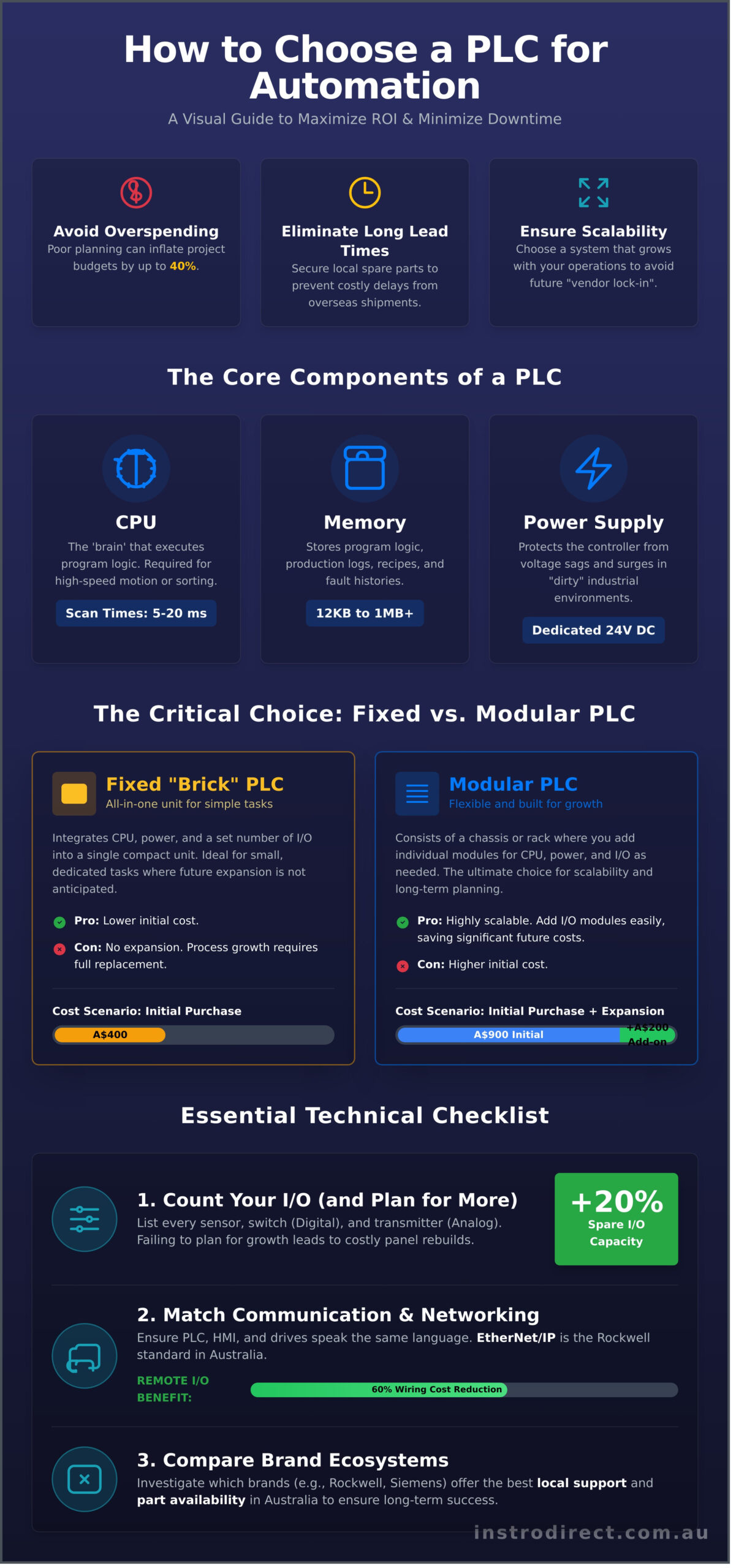
The actual cost of PLC procurement can significantly inflate project budgets, potentially leading to overspending by 40%. This is often exacerbated by challenges such as lengthy lead times for critical replacement parts within Australia, the complexities of software licensing, and the ongoing concern of selecting a system that won’t effectively scale with your operations.
This comprehensive InstroDirect guide cuts through the complexity. We provide a master list of technical and financial criteria for how to choose a plc for automation that minimizes downtime and maximizes your ROI. Our objective extends beyond merely finding a functional unit; it’s about securing the optimal hardware while significantly reducing procurement costs and guaranteeing the long-term availability of local spare parts.
Prepare to master a practical selection process, encompassing a clear technical checklist for I/O and communication, alongside proven strategies to significantly lower your hardware costs. With our guidance, you can eliminate the frustration of waiting on parts from overseas.
Key Takeaways
- Calculate your exact I/O count and match communication protocols to your plant network to avoid costly integration errors.
- Compare major PLC brands like Rockwell and Siemens to understand which ecosystem offers the best part availability and support in Australia.
- Master a step-by-step process for how to choose a plc for automation, from initial technical specs to final selection, to maximise your ROI.
- Discover sourcing strategies beyond authorised distributors to get genuine, brand-new PLC hardware at a lower price.
What is a PLC and How Does it Drive Automation Efficiency?
A Programmable Logic Controller (PLC) is not a standard office computer. It’s a ruggedised industrial computer built to run 24/7 in harsh environments. Think of the dust, vibration, and temperature extremes found in Australian mining operations or food processing plants. This is where PLCs operate. As defined by sources like Wikipedia, a Programmable Logic Controller (PLC) is the brain of modern automation, executing commands with precision and reliability. Its primary role is to eliminate manual intervention, which directly increases production speed and guarantees repeatability. Every action is identical, reducing defects and improving quality control, often boosting line output by over 20%.
The technology has advanced significantly from the original relay-based systems of the 1960s. Today’s high-speed controllers, like the Allen-Bradley Micro 800 series, process logic in milliseconds. Understanding this power is the first step in learning how to choose a plc for automation. Selecting the right platform from the start is a critical business decision. Committing to a specific brand means investing in its entire ecosystem of software and hardware. Choosing incorrectly can lead to expensive “vendor lock-in,” forcing costly system overhauls and retraining down the line. A smart initial choice future-proofs your facility and protects your investment.
The Core Components of an Automation Controller
Every PLC system, regardless of size, is built on three fundamental components. Your application’s demands will dictate the specifications for each.
- CPU (Central Processing Unit): This is the brain. It executes the user-programmed logic at high speed, with scan times often between 5-20 milliseconds. Faster CPUs are required for motion control or high-speed sorting applications.
- Memory: This stores the program logic and operational data. A simple conveyor control might only need 12KB of memory, while a complex batching system could require over 1MB to store recipes, production logs, and fault histories.
- Power Supply: Industrial environments have “dirty” power. A dedicated 24V DC power supply is essential to protect the controller from voltage sags and surges, ensuring consistent operation and preventing costly shutdowns.
Fixed vs. Modular PLC Designs
One of the most important decisions in how to choose a plc for automation is selecting between a fixed or modular design. The choice directly impacts both initial cost and long-term scalability. Fixed I/O controllers, often called “brick” PLCs, integrate the CPU, power supply, and a set number of inputs/outputs (I/O) into one unit. They are ideal for small, dedicated tasks where expansion is not anticipated, like a simple pump-off controller.
Modular systems offer flexibility. They consist of a chassis or rack where you can add individual modules for the CPU, power supply, and various types of I/O. If you need more inputs next year, you simply add another input card. This design is built for growth. The cost trade-off is clear: a fixed PLC might save you A$400 upfront, but if your process expands, you must replace the entire unit. A modular system may have a higher initial cost of A$900, but adding a new I/O module later could be as little as A$200, saving significant money and downtime. It’s the classic dilemma of buying for today versus planning for tomorrow.
Technical Criteria: Matching PLC Specifications to Your Application
The core of any automation project is matching PLC specs to the job. Get this wrong, and you face production downtime or overspend by thousands of dollars. It’s not about buying the most powerful processor. It’s about buying the right one. This section breaks down the critical technical details you can’t ignore.
Understanding I/O Requirements and Expansion
First, count your I/O. Differentiate between digital (on/off signals from push buttons) and analogue (variable 0-10V or 4-20mA signals from pressure transmitters). Some jobs need specialty modules like high-speed counters for encoders or thermocouple inputs for precise temperature control. Always plan for 20% spare I/O capacity. This future-proofs your panel for later modifications without a total rebuild, saving huge labour costs.
Communication and Networking Standards
In Australia, EtherNet/IP is the standard for Rockwell Automation systems. This makes integration with PowerFlex VFDs and PanelView HMIs simple. For big production lines, remote I/O blocks like Allen-Bradley’s POINT I/O slash wiring costs by up to 60% compared to running every cable back to one cabinet. Ensure your PLC, HMI, and drives speak the same language from day one to avoid expensive compatibility headaches.
A proper I/O count is your starting point. Walk the machine and list every single device.
- Inputs: Proximity sensors, photo-eyes, limit switches, e-stops.
- Outputs: Solenoid valves, motor contactors, stack lights, alarms.
A small conveyor system might need 12 digital inputs and 8 digital outputs. A process skid could require 4 analogue inputs (pressure, flow) and 2 analogue outputs (for a control valve). This list dictates the size and cost of your PLC hardware.
Processor scan time is critical for performance. It’s the time the PLC takes to run its program loop once. For simple tank level control, a 50-100 millisecond scan time is fine. But for a high-speed packaging line running 300+ products per minute, you need a scan time under 10 milliseconds to avoid missed product detection. A basic Micro820 can’t keep up. You need a CompactLogix or ControlLogix processor. This is a vital step in how to choose a plc for automation correctly.
Don’t forget the environment. Australian industrial sites are harsh. A non-air-conditioned switch room in a Western Australian mine can easily exceed 50°C. While many PLCs are rated to 60°C, their performance de-rates in high heat. You may need a specific model like Allen-Bradley’s ControlLogix XT (eXtreme Temperature) series, rated to 70°C. For sites with heavy vibration or electrical noise from large VFDs, look for PLCs with conformal coating and robust isolation that meets IEC 61131-2 standards to prevent processor faults.
A full technical audit is the foundation of your decision. It stops you from buying an underpowered unit that fails under load or an overpowered one that blows the budget. Get your I/O list, communication needs, and environmental specs sorted first. If you have the specs but can’t find the right module at the right price, check our huge stock of Allen-Bradley and Siemens PLCs for deals that beat manufacturer RRP by up to 40%.
Rockwell vs. Siemens vs. Schneider: Choosing Your Brand Ecosystem
Selecting a PLC isn’t just about one controller. You’re buying into a complete ecosystem of hardware, software, and support. In Australia, your choice often comes down to three major players. A key factor in how to choose a plc for automation is understanding which brand’s ecosystem best fits your budget, application, and your team’s existing skills.
Don’t just look at the upfront hardware cost. Consider the long-term expenses. Software licensing, spare parts availability, and technician training can easily double your initial investment over the life of the machine.
Rockwell Automation and the PowerFlex Advantage
In Australia, Rockwell’s Allen-Bradley is the default choice for many. Their market dominance, particularly in mining and manufacturing, means parts are everywhere and experienced technicians are easy to find. The real power comes from the tight integration within their ecosystem. Pairing a ControlLogix or CompactLogix PLC with a PowerFlex VSD using Studio 5000 software is seamless. Commissioning is faster, and diagnostics are simplified, saving valuable downtime. For smaller jobs, the Micro 800 series offers a powerful, cost-effective entry point without the high cost of a full Studio 5000 license. It’s the go-to for many small-to-midsize Australian machine builders. Check our current stock and get the best prices on all Rockwell and Allen-Bradley PLCs.
Siemens and Schneider: The European Alternatives
Siemens and Schneider Electric offer compelling, high-performance alternatives. Siemens, with its SIMATIC S7 series (like the S7-1200 and S7-1500), is known for precision and power. It excels in complex, high-speed manufacturing where reliability is non-negotiable. Its Totally Integrated Automation (TIA) Portal is an incredibly powerful, all-in-one engineering environment, but it comes with a steeper learning curve for teams accustomed to Rockwell. Schneider Electric’s Modicon controllers and Altivar drives are strong contenders, especially in process industries like water treatment. They often provide a more competitive price point for comparable performance, making them an excellent value proposition.
Your team’s programming preference matters. While all three support Ladder Logic (LD), Rockwell’s environment is heavily LD-centric. Siemens and Schneider offer more robust support for other languages like Structured Text (ST), which can be more efficient for complex algorithms and data handling, appealing to engineers with a background in IT or C++.
Ecosystem Costs: Beyond the PLC
The sticker price of the PLC is just the beginning. The total cost of ownership is what truly impacts your budget. Here’s a quick breakdown:
- Software Licensing: A basic license for Rockwell’s Studio 5000 can start around A$2,000, with professional editions easily exceeding A$10,000. A comparable Siemens TIA Portal license might start lower, but advanced function block libraries carry extra costs. Schneider’s EcoStruxure Control Expert is often more competitively priced.
- Training: Don’t underestimate this cost. Sending a single technician to a 5-day certified Rockwell or Siemens training course in Australia typically costs between A$3,000 and A$4,500. If your team is unfamiliar with a new platform, this is a mandatory expense. This is a critical point when considering how to choose a plc for automation for a new facility.
- Part Availability: Rockwell’s dominance in Australia ensures massive local stock. For Siemens and Schneider, sourcing specific parts can sometimes mean longer lead times, which is why sourcing through a parallel importer like InstroDirect can save you both time and money.
Sourcing Strategies: How to Save on Genuine PLC Hardware
Choosing your PLC hardware is only half the battle. The other half is sourcing it without destroying your budget. It’s a common myth that you must buy from authorised Australian distributors to get genuine, factory-sealed equipment. This traditional model forces you to pay for multiple layers of markups and corporate overhead, driving up costs for essential components.
There is a smarter way. By using a parallel import model, you can source the exact same brand-new, genuine parts from global markets at significantly lower prices. This isn’t about finding cheap alternatives; it’s about accessing authentic hardware from brands like Allen-Bradley, Siemens, and Schneider Electric without paying the inflated local Recommended Retail Price (RRP). A key part of knowing how to choose a plc for automation is understanding this total cost of ownership, especially for maintenance and spares.
Avoiding High Manufacturer Markups
Why pay more for the same product? Traditional distribution channels in Australia include costs for marketing, sales teams, and complex logistics networks. These costs are passed directly to you. A direct-to-consumer industrial supply model cuts out these expensive middlemen. This means you can SAVE OVER 40% FROM MANUFACTURER RRP on critical PLC modules, VSDs, and HMIs. For any maintenance manager, this translates to a healthier budget and the ability to stock more critical spares. You can check the shop for latest deals on all major brands right now.
Lead Times and Critical Spares
Production is down. You need a specific ControlLogix processor, but the official channel quotes a 12-week lead time. This is a real-world scenario that costs Australian businesses thousands of dollars per hour in lost production. Waiting simply isn’t an option. Your strategy for how to choose a plc for automation must account for part availability. Sourcing from a supplier with local stock in Queensland means you get faster nationwide shipping, often overnight. This drastically reduces downtime.
Parallel importing is a legal, cost-effective way to source genuine global brands directly for the Australian market.
Beyond price and speed, you need support you can count on. When a technical issue arises, you can’t afford to wait for an overseas call centre. Having access to Australian-based technical support provides practical troubleshooting from experts who understand local conditions and applications. It’s the final piece of the puzzle: genuine parts, massive savings, fast delivery, and local expertise. Don’t let supply chain issues and high prices dictate your operational success. Contact us directly to source the genuine PLC parts you need, fast.
Final Selection Checklist and Next Steps
You’ve analysed your application requirements and narrowed down the options. Before you commit to a purchase, run through this final checklist. Getting these details right prevents costly delays and ensures the hardware you buy is the hardware you need. This final verification is the most critical step in how to choose a plc for automation.
Use this quick-fire list to confirm your choice:
- Confirm I/O and Signal Types: Double-check your final count. Do you need 16 digital inputs or 18? Do you need 4 analogue outputs or 6? A simple miscalculation can lead to ordering the wrong module. Remember that analogue modules, like a Siemens 6ES7532-5HD00-0AB0, carry a higher cost per channel than standard digital I/O modules like a Rockwell 1769-IQ32. Lock in your exact counts now.
- Verify Communication Protocol: Your new PLC must speak the same language as your existing network. If your plant runs on EtherNet/IP, a PROFINET-only PLC is a non-starter without expensive gateways. Check that the PLC’s native protocol matches your VFDs, HMIs, and other controllers. Don’t assume compatibility.
- Check Software and Licensing: This is a hidden cost that catches many engineers out. A new Allen-Bradley controller requires a Studio 5000 license, a significant investment that can exceed A$5,000 for a single seat. A Siemens PLC needs TIA Portal. Confirm your existing licenses will support the new hardware or budget for a new software purchase.
- Compare Total Landed Price: Look beyond the sticker price. Compare the manufacturer’s RRP with InstroDirect’s parallel import prices. You can often SAVE OVER 40% on identical, factory-sealed hardware. Our model cuts out the middleman, passing those savings directly to you.
- Can’t Find a Part Number?: If a specific part number isn’t listed on our website, don’t give up. We can source thousands of parts directly. Your next step is to contact our team.
The Procurement Decision: Price vs. Availability
Price is a major driver, but a cheap PLC with a 20-week lead time won’t get your line running. We balance aggressive pricing with strong stock availability. Why pay full RRP and still wait? We also provide free shipping on all Australian orders, lowering your total cost of ownership. Can’t find that specific Rockwell ControlLogix CPU or Siemens S7-1200 module? Ring our Narangba office for direct sourcing help.
Expert Support for Your Selection
Still unsure if a specific module is the right fit? Don’t risk it. Expert phone support is available during business hours to verify compatibility and specifications. Technical help is just a call away, ensuring you get the right part the first time. Our team provides the practical support you need for how to choose a plc for automation correctly. Get the best prices and the right advice.
Shop the full range of PLCs and Drives now.
Finalize Your PLC Selection and Save
You’ve walked through the critical technical criteria and weighed the major brand ecosystems. Now, you have a clear, practical framework for how to choose a plc for automation. The final decision hinges on matching I/O counts, memory, and processing speed to your specific application’s demands. But your work isn’t done until you source that hardware at a price that protects your project budget.
This is where InstroDirect delivers unmatched value. Through our parallel importing model, we provide access to genuine, factory-sealed PLC hardware from leading brands including Rockwell, Siemens, and Schneider. Why pay full manufacturer RRP when you don’t have to? We give you the parts you need, with Free Shipping on all orders and the confidence of our expert Australian-based support team.
Stop overpaying for essential components. Put our selection guide into action and equip your facility with the best. SAVE OVER 40% ON GENUINE PLCS – SHOP NOW.
Frequently Asked Questions About Choosing a PLC
How do I know if a PLC is compatible with my existing HMI?
A key step in how to choose a plc for automation is ensuring it works with your HMI. Compatibility depends on the communication protocols and drivers supported by both devices. Check the HMI’s technical datasheet for a list of supported PLC drivers. For example, a Red Lion HMI supports over 300 drivers, including those for Siemens and Allen-Bradley. If both support a common protocol like Modbus TCP/IP or OPC UA, they can communicate directly.
What is the difference between a PLC and a PAC?
A PAC (Programmable Automation Controller) has more processing power, memory, and flexibility than a standard PLC. PLCs excel at high-speed sequential logic, while PACs are built for complex automation with motion control, process control, and large data sets. For example, a ControlLogix PAC can manage hundreds of motion axes, whereas a Micro820 PLC is designed for smaller machine control. PACs typically cost 20-50% more for a comparable I/O count.
Can I use a Siemens PLC with an Allen-Bradley VFD?
Yes, you can connect a Siemens PLC to an Allen-Bradley VFD using a common industrial protocol. While Siemens S7 PLCs use PROFINET natively and Allen-Bradley PowerFlex VFDs use EtherNet/IP, many devices support multiple protocols. You could use a VFD model that supports PROFINET or use a protocol gateway to translate between networks. The simplest method is often using a universal protocol like Modbus TCP if both devices support it, which most modern units do.
Why are parallel imported PLCs cheaper than distributor prices?
Parallel imported PLCs are cheaper because they are sourced from overseas markets with lower pricing and sold directly, cutting out the authorised Australian distributor’s margin. This direct sourcing model avoids local price structures set by the manufacturer for the Australian region. This means you can often save over 40% from the manufacturer’s recommended retail price (RRP) in Australia. You get the same genuine product, just through a more cost-effective supply chain.
What programming language should I use for my PLC?
When deciding how to choose a plc for automation, the programming language is a practical factor. For over 90% of applications, Ladder Diagram (LD) is the standard and easiest for electricians to troubleshoot. If your process is more complex, Function Block Diagram (FBD) works well for process control. For data-heavy tasks, Structured Text (ST) is more efficient. These are all part of the IEC 61131-3 standard, making skills transferable between PLC brands.
Do I need a specialty I/O module for high-speed counting?
Yes, a dedicated high-speed counter (HSC) module is necessary for applications with input frequencies above the PLC’s main scan time, typically anything over 1 kHz. Standard digital inputs can miss fast pulses from devices like encoders or turbine flow meters. An HSC module has its own processor to count pulses independently of the PLC scan, ensuring no counts are missed. For example, an Allen-Bradley 1756-HSC module can handle inputs up to 1 MHz.
What happens if a PLC model is discontinued or legacy?
When a PLC model like the Siemens S5 or Allen-Bradley PLC-5 is discontinued, you have two options. You can source refurbished or new-old-stock units from independent suppliers like us who specialise in hard-to-find parts. This is a fast, low-cost fix to get a line running again. The long-term solution is a planned migration to a modern equivalent, such as upgrading from a PLC-5 to a ControlLogix platform, which involves hardware and program conversion.
Is there a warranty on PLCs purchased through parallel importers?
Yes, we provide our own 12-month replacement warranty on all PLCs sold. Because the product is parallel imported, it isn’t covered by the manufacturer’s official Australian warranty; the warranty is with us, the direct seller. This is a key part of how we offer lower prices. If a unit fails within the warranty period due to a defect, we will replace it directly, providing a fast solution without involving the manufacturer’s local service channels.
Leave a Comment
Your email address will not be published. Required fields are marked *