
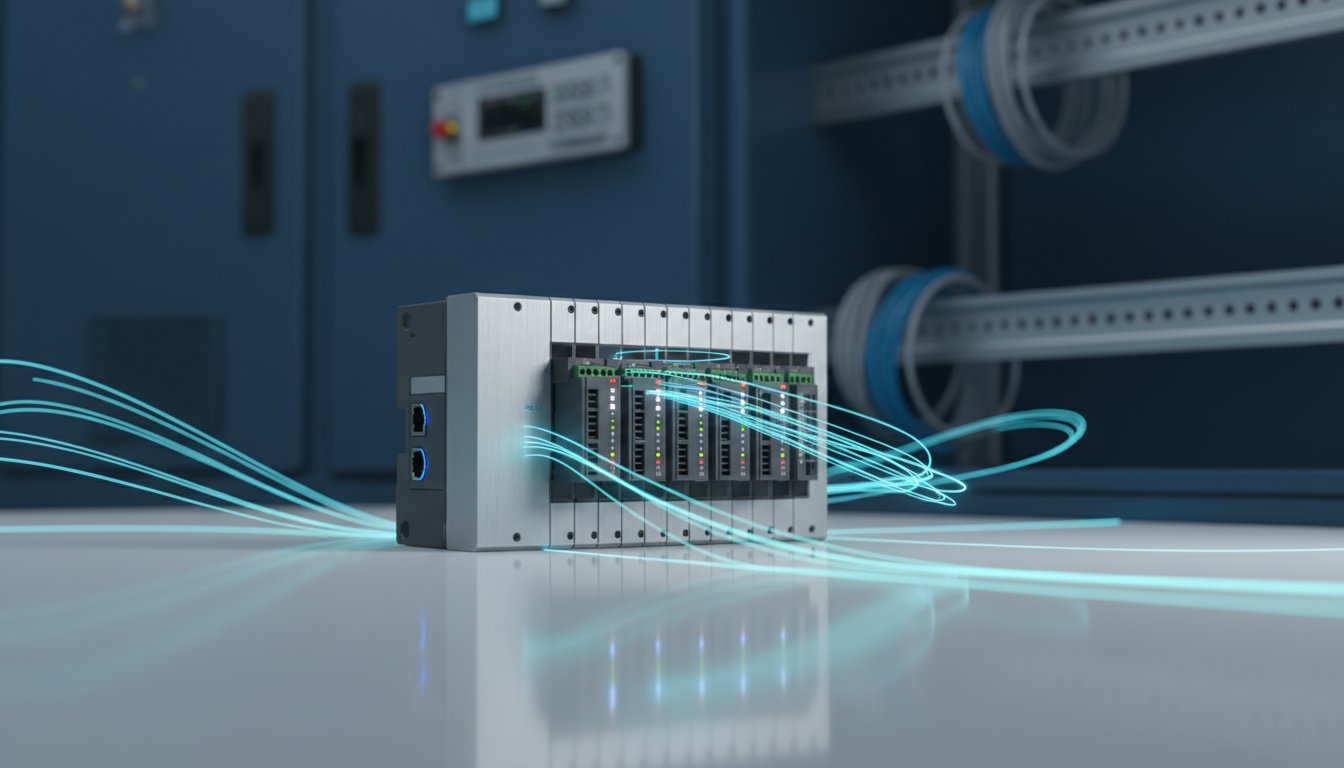
Need to understand a Programmable Logic Controller, fast? Don’t waste time on complex theory. If you’re an engineer or technician, you need practical answers. What is a plc? How is it different from a PC? What do terms like ‘scan cycle’ or ‘I/O’ actually mean for your job? Choosing the wrong unit costs time and money, something no Australian project can afford.
This guide is your direct resource. No fluff. We provide a simple definition and explain exactly how a PLC works. You’ll learn the key types-compact, modular, and rack-mounted-and their best use cases. We cut through the confusion of programming languages and help you identify the right controller for your specific application. Get the information you need to select the correct PLC from brands like Rockwell, Siemens, or Schneider Electric at the best possible price. Get it right the first time.
Key Takeaways
- Understand that a programmable logic controller (PLC) is a rugged industrial computer that automates machinery through a simple 3-step scan cycle.
- Distinguish between Compact and Modular PLCs to select the right form factor for your application’s budget, space, and I/O requirements.
- See how PLCs are used to improve efficiency and safety across key Australian industries, from mining to food and beverage processing.
- Identify the major PLC brands available in Australia, including Rockwell, Siemens, and Schneider, to make a better purchasing decision.
What is a Programmable Logic Controller (PLC)?
A Programmable Logic Controller (PLC) is a ruggedised industrial computer that forms the backbone of modern automation. Its core function is to control machinery and processes with extreme reliability in harsh industrial environments. Unlike a standard desktop computer, a PLC is engineered to withstand vibration, extreme temperatures, and electrical noise common on a factory floor or at a remote Australian mine site. For a complete technical overview, Wikipedia provides a comprehensive resource on What is a Programmable Logic Controller (PLC)?, but for practical purposes, it’s the purpose-built brain for your machinery.
The key advantages of any modern plc are its reliability, durability, and modularity. These systems are designed for non-stop operation and can be easily expanded or modified, providing a cost-effective and scalable solution for complex automation tasks. This sets them apart from less robust microcontrollers (like Arduino) or inflexible hard-wired relays.
The Brains of Modern Industry
Think of a PLC as the nervous system of your operation. It takes information from sensors (inputs), makes decisions based on its program (logic), and sends out commands to actuators like motors and valves (outputs). Invented by Dick Morley for the American automotive industry, the PLC was created to replace massive, complex, and failure-prone relay logic cabinets. Its purpose was simple: provide a more efficient, programmable, and easier-to-troubleshoot alternative to thousands of physical wires and relays.
PLC vs. PC: Key Differences
While both are computers, a PLC is a specialist tool built for a specific job. Using a standard PC for industrial control is inefficient and unsafe. The core differences come down to design and function:
- Operating System: A PLC uses a Real-Time Operating System (RTOS) that executes commands instantly and predictably. A PC’s general-purpose OS (like Windows) can have delays that would be catastrophic in high-speed manufacturing.
- Hardware: PLCs are solid-state devices with no moving parts, built to handle industrial hazards. They are designed to operate reliably in conditions that would destroy a commercial PC.
- Inputs & Outputs (I/O): A PLC features built-in, protected I/O ports designed to connect directly to industrial-grade sensors, switches, and actuators.
- Programming: PLCs are programmed using specialised languages like Ladder Logic, which mimics electrical relay diagrams, making it intuitive for electricians and technicians to use and maintain.
How a PLC Works: Core Components and the Scan Cycle
At its core, any programmable logic controller (PLC) operates in a simple, repeating loop. This is the PLC scan cycle. This high-speed process is how the controller reads real-world data, makes logical decisions based on your program, and controls machinery with reliable precision. Understanding this cycle and the core components is essential for troubleshooting and optimising any automated system in Australia.
Inside the Box: Key Hardware Components
A PLC system is built from four essential hardware types. Getting the right combination is key to performance and saving on costs.
- CPU (Central Processing Unit): The brain of the operation. It executes your program logic and handles all calculations. A more powerful CPU means a faster scan time and the ability to run more complex programs.
- Memory (RAM/ROM): Stores the PLC’s operating system (firmware) and your user-created program (e.g., ladder logic). More memory allows for larger, more sophisticated control strategies.
- Input/Output (I/O) Modules: The hands and ears of the PLC. These modules are the physical connection points to real-world devices like sensors, switches, motors, and valves.
- Power Supply: Delivers stable, clean DC power to the CPU and other modules. A high-quality power supply is critical for system reliability in harsh industrial environments.
The PLC Scan Cycle Explained
The entire operation happens in milliseconds. This four-step process repeats continuously as long as the PLC is in RUN mode. The total time for one complete loop is the scan time, a critical performance metric for high-speed applications.
- Step 1: Input Scan – The PLC checks the status of every input device connected to it. Is the emergency stop button pressed? Is the level sensor tripped? It saves these states in its memory.
- Step 2: Program Execution – The CPU runs your program from top to bottom, one instruction at a time, using the input data it just collected to solve the logic.
- Step 3: Output Scan – Based on the program’s results, the PLC updates the status of all connected output devices. It turns motors on, opens valves, or activates indicator lights.
- Step 4: Housekeeping – The PLC performs internal diagnostics and handles communication tasks, such as talking to a touch screen (HMI) or another controller.
Understanding PLC Inputs and Outputs (I/O)
I/O is how your PLC interacts with the plant floor. Choosing the right mix of I/O modules is critical for both project cost and system performance. They come in two main types:
- Digital (Discrete) I/O: For simple ON/OFF signals. Think of a pushbutton, a proximity sensor, or a simple indicator light. The signal is either present or it isn’t.
- Analog I/O: For variable signals that represent a range of values. This is used for sensors measuring temperature, pressure, or flow, which typically provide a 4-20mA or 0-10V signal.
You can also get specialty modules for more complex tasks, like high-speed counters for encoders, motion control modules for servo drives, or communication cards for industrial networks like EtherNet/IP or PROFINET.

The Main Types of PLCs: Compact vs. Modular
When selecting a PLC, the first major decision is its physical form factor. Your choice comes down to two main types: Compact or Modular. Each offers a different balance of cost, size, and flexibility, directly impacting your project’s budget and future potential. Understanding the trade-offs is key to getting the best value for your application.
Compact (Fixed or Brick) PLCs
A compact PLC, often called a “brick,” is an all-in-one unit. The CPU, power supply, and a fixed number of digital and analogue inputs/outputs (I/O) are all housed in a single, self-contained case. This design offers a straightforward, cost-effective solution for specific tasks.
- Advantages: Lower initial cost, simple to install, and a small footprint perfect for tight control panels.
- Limitations: The number of I/O points is fixed. Expandability is minimal or completely non-existent.
- Best for: Small-scale machines, simple automation tasks, and standalone equipment where the I/O count is known and will not change.
Modular PLCs
Modular PLCs are built for flexibility and power. They use a rack or chassis system where you can add, remove, or swap individual modules to build a completely custom controller. This approach is ideal for complex and evolving systems.
- Components: A typical setup includes a backplane or rack, a separate CPU module, a power supply module, and various I/O modules (e.g., digital, analogue, communication, high-speed counters).
- Advantages: Highly scalable for future growth, easy to repair by just swapping a faulty module, and supports advanced functions and large I/O counts.
- Best for: Complex manufacturing processes, entire production lines, and any system where future expansion and upgrades are expected.
Which Type is Right For You?
Choosing the right plc form factor saves time and money. Ask these key questions before you buy:
- I/O Count: How many inputs and outputs do you need now? Crucially, do you expect to add more in the future? If future growth is likely, a modular system is a safer investment.
- Physical Space: How much room is available in your control cabinet? Compact PLCs are the clear winner for tight spaces.
- Budget: Compact PLCs have a lower upfront cost, making them great for budget-sensitive projects. Modular systems require a larger initial purchase but offer better long-term value for growing applications.
Ready to find the best-priced controller for your job? Explore a wide range of PLCs and I/O modules in our shop to get the best deals in Australia.
Real-World PLC Applications Across Australian Industries
Programmable Logic Controllers (PLCs) are the backbone of modern Australian industry. They are the unseen brains behind the machines that build our infrastructure, extract our resources, and produce our food. A reliable plc system directly translates to higher efficiency, better safety, and increased profitability across every sector.
From the factory floor to the mine site, these robust controllers execute commands with precision, ensuring processes run without costly errors or downtime. Their versatility makes them indispensable for any automated task.
Manufacturing and Assembly Lines
In high-speed production environments, PLCs command entire lines with split-second accuracy. This automation is critical for maintaining a competitive edge and delivering consistent product quality. Key applications include:
- Robotic Automation: Controlling welding, painting, and assembly arms for vehicle and component manufacturing.
- Material Handling: Managing conveyor speeds and sorting gates to move products seamlessly through a facility.
- Packaging & Bottling: Ensuring every product is filled, capped, labelled, and packed correctly.
- Quality Control: Triggering cameras and sensors for automated inspection, instantly identifying and rejecting faulty items.
Mining and Resources
Australia’s demanding mining sector relies on the rugged durability of PLCs to operate safely in harsh conditions. In this critical industry, PLCs manage systems that protect workers and maximise operational uptime.
- Heavy Machinery Control: Operating massive ore crushers, grinding mills, and stacker-reclaimers.
- Environmental Management: Automating vital underground ventilation and water de-pumping systems.
- Processing Plant Automation: Managing the sorting and processing of minerals for maximum yield.
- Safety Monitoring: Constantly checking equipment status and emergency stop systems to protect personnel.
Food, Beverage, and Agriculture
From the farm to the supermarket shelf, PLCs guarantee the quality and consistency of Australian produce. They manage precise processes where even small deviations can impact the final product.
- Batching & Mixing: Controlling ingredient measurement and mixing times for everything from bread to sauces.
- Climate Control: Regulating temperatures in industrial ovens, pasteurisers, and freezers.
- Modern Farming: Automating irrigation schedules and greenhouse climate systems for optimal crop growth.
- Breweries & Wineries: Ensuring repeatable quality by managing fermentation temperatures and timing.
The right controller is essential for any automated system. If your operation needs a specific PLC from brands like Allen-Bradley, Siemens, or Schneider, InstroDirect offers the best prices through parallel importing. Find the parts you need to keep your industry moving.
Choosing Your First PLC: Major Brands and Key Factors
Selecting the right Programmable Logic Controller (PLC) is a critical decision for any automation project. In Australia, you have access to the world’s leading brands, but matching the right hardware to your application and budget is key to success. This section explores the characteristics of leading brands, the essential selection criteria, and how to source your hardware for the best price.
Navigating the PLC Brand Landscape
The Australian market is served by a few global giants. Your choice will often be influenced by your industry, existing equipment, and team familiarity.
Leading brands typically offer robust platforms known for reliability across various industries. They often feature comprehensive product ranges, from compact controllers for simple tasks to powerful programmable automation controllers (PACs) for complex, high-performance applications. These global providers cater to diverse automation needs, and their solutions are widely adopted as industry standards.
Other brands like Omron, Mitsubishi, and Beckhoff also have a significant presence, often excelling in specific niches like high-speed packaging, robotics, or PC-based control.
Key Selection Criteria
Before you purchase any plc, evaluate your project against these core requirements to ensure you get what you need without overspending.
- I/O Count & Type: How many inputs (sensors, buttons) and outputs (motors, lights) do you need to control? Tally up your digital (on/off) and analog (variable signal) points.
- Memory & Processing Speed: A simple conveyor control program requires far less power than a high-speed motion control application. Match the CPU’s capability to your program’s complexity.
- Communication Protocols: Your PLC must talk to other devices. Confirm it supports the necessary networks, such as commonly used industrial Ethernet protocols or fieldbus systems.
- Programming Environment: Does your team have familiarity with specific programming environments? Choosing a familiar software platform saves significant time and training costs.
Where to Source PLCs in Australia
Traditionally, PLCs are bought through authorised distributors, but this channel often includes significant markups. For smarter procurement, direct sourcing through a parallel importer is the most cost-effective solution.
Direct sourcing provides access to genuine, factory-sealed products at globally competitive prices, bypassing local distribution costs. This means you get the authentic hardware you need, often with better availability and at a lower price point. We, InstroDirect, stand by the authenticity of our products and provide the support to get you operational.
Ready to save on your next project? Get great deals on genuine PLCs here.
Your Next Step: Sourcing the Right PLC for the Job
From the fundamental scan cycle to the critical choice between compact and modular systems, you’re now equipped with the essential knowledge to approach any automation task. Understanding how a Programmable Logic Controller functions is the first step; selecting the right hardware is what brings your Australian industrial project to life and guarantees its long-term success.
Sourcing that hardware shouldn’t be a roadblock. At InstroDirect, we make it simple and cost-effective. Through our direct parallel importing model, we offer highly competitive pricing on all major brands, including Rockwell, Siemens, and Schneider Electric. You get the genuine parts you need for less, all backed by expert, practical support from our Australian-based technicians.
Can’t find the specific plc model you’re looking for? We are here to help. Save time and get the best price. Contact us directly for a quote! We’ll source the exact components you need to keep your operations running at peak performance.
PLC: Frequently Asked Questions
What are the 5 main PLC programming languages?
The five standard languages defined by IEC 61131-3 are Ladder Diagram (LD), Function Block Diagram (FBD), Structured Text (ST), Instruction List (IL), and Sequential Function Chart (SFC). LD is the most common, visually resembling electrical relay logic. ST is a high-level text-based language ideal for complex calculations, while FBD uses graphical blocks for process control. Each language is suited for different automation tasks and user backgrounds.
Can a PLC be used for home automation?
Yes, but it is often overkill for simple jobs. While a consumer smart device is cheaper, a PLC offers industrial-grade reliability for complex or critical home automation projects. For advanced users wanting total control over HVAC, security, and lighting systems without relying on cloud services, a compact plc is an excellent, robust solution. It provides unmatched stability and customisation compared to standard off-the-shelf home automation products.
This level of control is even being applied to sophisticated residential amenities. For instance, modern swimming pools can involve complex automation for filtration, heating, and lighting, showcasing how industrial principles are adapted for home use. If you’re curious about the kinds of advanced residential setups available today, you can check out Mistri Piscine for examples.
How long does a typical industrial PLC last?
Industrial PLCs are built to be extremely durable. A typical lifespan is 15 to 20 years, with many units operating reliably for much longer. Longevity depends on the operating environment-factors like heat, dust, vibration, and electrical stability play a major role. Unlike consumer electronics, PLCs use high-grade components designed for continuous 24/7 operation in harsh industrial conditions, ensuring a long and dependable service life.
What is the difference between a PLC and a DCS (Distributed Control System)?
The main difference is scale and application. A PLC is designed for high-speed, discrete control of a single machine or a small, localised process like a production line. A DCS is built for managing large, continuous, and complex plant-wide processes, such as those in an oil refinery or power station. A DCS integrates regulatory control, data acquisition, and system monitoring across many distributed controllers, whereas a PLC focuses on fast logic execution for a specific task.
Is it difficult to learn how to program a PLC?
The difficulty depends on your background. For electricians familiar with schematic diagrams, learning Ladder Logic is often intuitive and quick. For those with a background in IT or computer science, text-based languages like Structured Text may be easier to grasp. Basic programming for simple on/off logic is straightforward, but mastering advanced functions, motion control, and networking requires dedicated training and hands-on experience.
What does a simple PLC setup cost?
In Australia, a basic setup has a variable cost. An entry-level micro PLC CPU from a major brand can start from A$300 to A$700. When you add a power supply, essential I/O modules, and cabling, a complete functional kit for a small project typically costs between A$800 and A$2,000+. Programming software for these smaller units is often free. For the best prices on specific models, contact us directly.
Leave a Comment
Your email address will not be published. Required fields are marked *