Can’t find what you’re looking for? Contact us directly — we’ll source it for you. - Sales@instrodirect.com.au | Call : 0403 082 383

Industrial Automation Blog

PLC vs DCS — What Is the Difference?

Programmable Logic Controllers (PLCs) and Distributed Control Systems (DCS) are both used to automate industrial processes, but they evolved from different engineering needs and are best suited to different types of applications. This guide explains the key differences to help engineers and project managers select the right control architecture.

What Is a PLC?

A PLC is a ruggedised industrial computer designed to control discrete and continuous processes in real time. PLCs were originally developed in the late 1960s as a replacement for relay-based control panels in automotive manufacturing. They are programmed using standard IEC 61131-3 languages — Ladder Diagram, Structured Text, Function Block Diagram and Sequential Function Chart.

PLC Characteristics

  • Fast deterministic scan times — typically 1 to 10 ms for discrete logic
  • Strong discrete I/O handling — ideal for sequential machine and process control
  • Modular and scalable — expand with additional I/O racks and remote I/O
  • Wide supplier choice: Rockwell Automation, Siemens, Schneider Electric, Mitsubishi, Omron
  • Generally lower upfront cost compared to an equivalent DCS
  • Common in manufacturing, mining, materials handling, water treatment and building services

What Is a DCS?

A Distributed Control System is a control architecture specifically designed for large, continuous process plants where thousands of analogue measurements must be monitored and controlled simultaneously. DCS systems distribute control functions across multiple field controllers connected via a high-speed proprietary network. The concept was developed in the 1970s to serve the process industries — oil and gas, chemicals, power generation and pharmaceuticals.

DCS Characteristics

  • Optimised for continuous analogue process control — temperature, pressure, flow and level loops
  • Integrated historian, alarm management, operator workstations and engineering station
  • High availability by design — redundant controllers, power supplies and network paths
  • Proprietary architecture supplied and supported by a single vendor (Honeywell, ABB, Emerson, Yokogawa)
  • Higher initial capital cost, but lower systems integration cost for very large plants
  • Common in oil refineries, petrochemical plants, power stations, LNG facilities and pharmaceutical manufacturing

PLC vs DCS — Key Differences

CharacteristicPLC SystemDCS
Primary applicationDiscrete and batch process controlContinuous analogue process control
Typical I/O countHundreds to a few thousand pointsThousands to tens of thousands of points
Scan timeFast — 1 to 10 msSlower — 100 to 500 ms typical
RedundancyAvailable but requires separate configurationBuilt in as standard at all levels
Supplier choiceMultiple competing open-market vendorsSingle proprietary vendor per system
Upfront hardware costLowerHigher
Integration cost at scaleHigher — more engineering effort requiredLower — integrated out of the box
Operator interfaceRequires separate SCADA or HMI systemIntegrated operator workstations included

When Should You Use a PLC?

  • Machine-level control — conveyors, packaging lines, presses, robotic cells
  • Batch processes with complex sequencing and discrete interlock logic
  • Small to medium water, wastewater or utility treatment plants
  • Mining and minerals processing automation with mixed I/O types
  • Projects where capital cost is constrained or multiple vendor quotes are required

When Should You Use a DCS?

  • Continuous process plants with very large analogue I/O counts
  • Applications where very high plant availability and built-in fault tolerance are mandatory
  • Oil and gas production, refining and petrochemical processing
  • Large coal, gas or renewable power generation facilities
  • Pharmaceutical manufacturing requiring 21 CFR Part 11 compliance and integrated batch records

The Convergence of PLC and DCS Technology

The line between PLC and DCS has blurred significantly over the past decade. Modern PLC platforms from Rockwell Automation (PlantPAx process automation system), Siemens (PCS 7 and PCS neo) and Schneider Electric (EcoStruxure Foxboro DCS) now deliver DCS-like capabilities — including controller redundancy, integrated historian, advanced regulatory control and ISA-88 batch management — on open hardware. These software-defined or PAC-based process control systems compete directly with traditional DCS vendors for mid-tier process automation projects.

PLC Hardware at InstroDirect

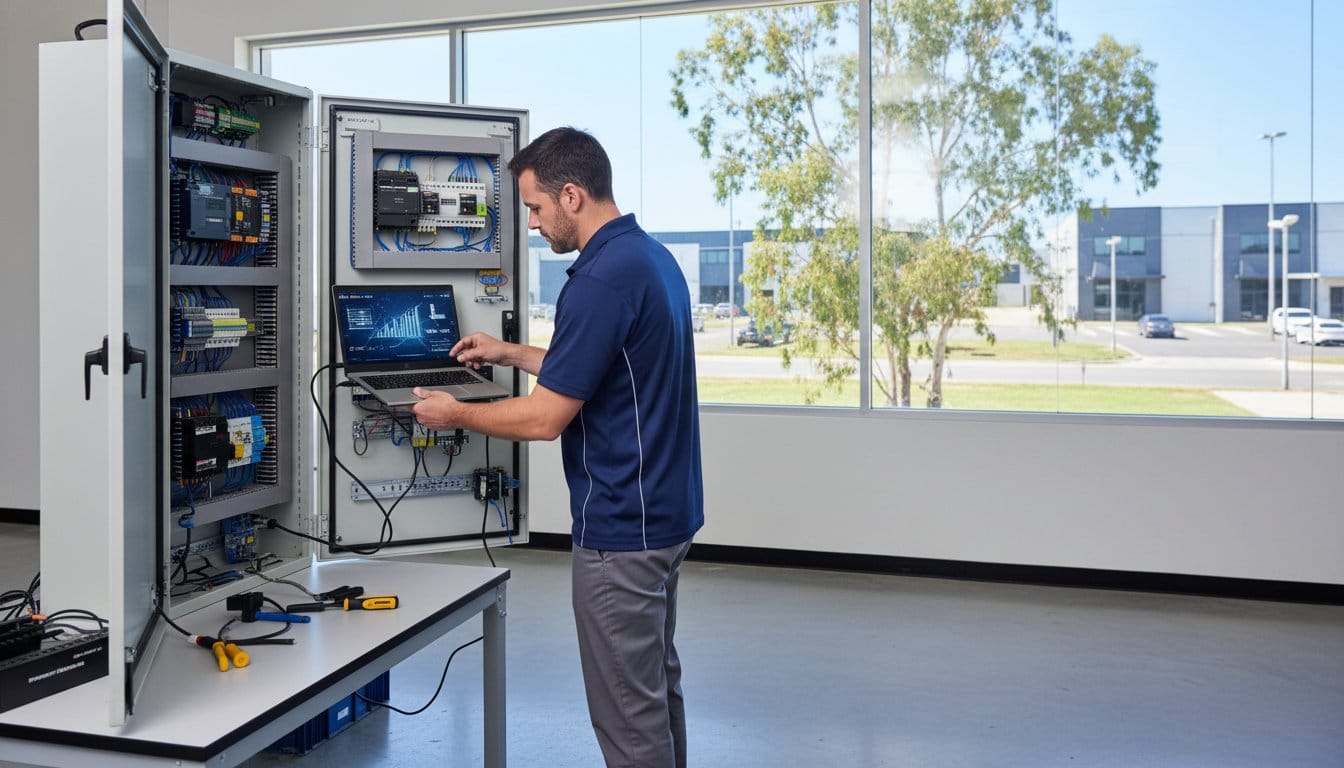
InstroDirect supplies genuine Allen-Bradley, Siemens and Schneider Electric PLC and PAC hardware for Australian engineering projects at parallel-import pricing. Whether you are designing a machine control panel, a batch plant or a mid-scale process automation system, our team can assist with hardware selection and provide competitive pricing. Contact us for a quote or visit the online store for current stock and availability.

Back to Top
Product has been added to your cart
Compare (0)