
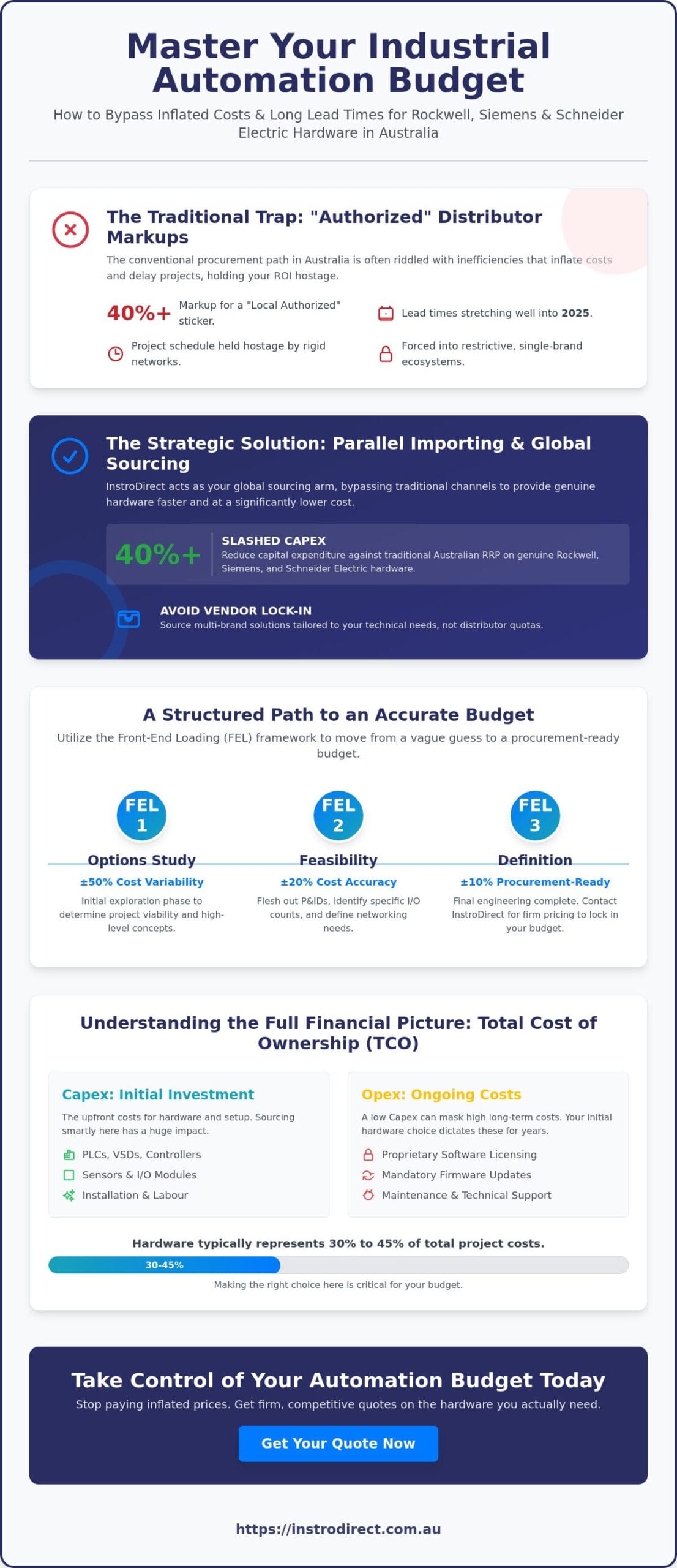
Paying a 40% markup just for a “Local Authorized” sticker isn’t a technical strategy; it’s a budget blowout waiting to happen. You already know that securing a reliable industrial automation cost estimate in Australia usually means wrestling with inflated vendor quotes and lead times that stretch well into 2025. It’s frustrating when your project ROI is held hostage by rigid distribution networks that don’t prioritize your bottom line or your project schedule.
This guide shows you how to master your automation budget by bypassing traditional markups and sourcing high-end Rockwell, Siemens, and Schneider Electric hardware more efficiently. At Instrodirect.com.au, we aren’t locked into a single brand. We provide the technical depth engineers need to justify every A$ spent on VSDs and PLCs. You’ll learn how to calculate true lifecycle costs, leverage parallel importing for significant Capex savings, and reduce lead times for critical components. We’re breaking down hardware procurement strategies and strategic sourcing methods that put the control back in your hands.
Key Takeaways
- Apply the FEL (Front-End Loading) framework to structure a precise industrial automation cost estimate that accounts for both Capex and long-term Opex.
- Identify technical cost drivers for PLCs and VSDs, including I/O density requirements and the energy-efficiency ROI of regenerative drives in Australian facilities.
- Slashed Capex by over 40% against traditional Australian RRP by leveraging parallel importing for genuine Rockwell, Siemens, and Schneider Electric hardware.
- Avoid vendor lock-in by using InstroDirect to source multi-brand solutions tailored to specific technical requirements rather than distributor quotas.
- Optimise procurement lead times and Total Cost of Ownership (TCO) by utilising a single global sourcing arm for all major automation brands.
The Core Pillars of an Industrial Automation Cost Estimate
Generating an accurate industrial automation cost estimate requires more than a cursory look at hardware catalogues. In the Australian manufacturing sector, generic “off-the-shelf” estimates consistently fail because they ignore the complexities of local brownfield integration and specific regulatory standards. Engineers must approach the budget through a structured framework that separates immediate capital requirements from long-term operational burdens. Instrodirect serves as your strategic sales arm, providing the technical data and part availability needed to move from a vague guess to a procurement-ready budget.
Effective budgeting starts with understanding the split between Capex and Opex. Capex covers the initial A$ investment in controllers, sensors, and installation labour. Opex involves the ongoing costs of keeping the system running. Because Instrodirect isn’t locked into one brand, we provide unbiased access to components from Allen-Bradley, Siemens, and Schneider Electric, allowing engineers to optimize their initial spend without being forced into restrictive proprietary ecosystems.
Front-End Loading (FEL) and Cost Accuracy
The FEL framework is the industry standard for narrowing down financial uncertainty. Skipping these steps leads to project blowouts that often exceed 30% of the original quote. Precision improves as the technical definition of the Automation system matures through three distinct phases:
- FEL 1 (Options Study): This is the initial exploration phase. Expect a high cost variability of ±50%. It’s used to determine if the project is viable.
- FEL 2 (Feasibility): Engineers flesh out the Piping and Instrumentation Diagram (P&ID). This stage narrows accuracy to ±20% by identifying specific I/O counts and networking requirements.
- FEL 3 (Definition): This produces procurement-ready quotes. With final engineering complete, the estimate hits ±10% accuracy. This is where you contact Instrodirect for firm pricing on specific part numbers to lock in the budget.
Capex vs. Opex: The Long-Term Financial View
A low Capex often masks aggressive Opex requirements. Hidden costs like annual software licensing and mandatory proprietary firmware updates can quickly eclipse the initial hardware savings. When selecting hardware at the Capex stage, you’re essentially dictating your maintenance costs for the next 10 years. Total Cost of Ownership (TCO) for PLC products must account for long-term firmware updates and technical support cycles.
Choosing a flexible hardware path is critical. By sourcing through Instrodirect, you avoid the “vendor lock-in” trap. We focus on providing the best price for the specific technical requirement, whether it’s a standalone micro-controller or a complex distributed I/O system. This independence ensures your industrial automation cost estimate remains realistic and shielded from single-vendor price hikes. If you can’t find the specific technical specs for a component, contact us directly for immediate assistance with your BOM (Bill of Materials).
Hardware Breakdown: Estimating Costs for PLCs, VSDs, and Sensors
Hardware components typically represent 30% to 45% of a total industrial automation cost estimate for Australian projects. For engineers, the primary hurdle isn’t just part selection; it’s bypassing the “brand tax” imposed by local authorized distribution networks. InstroDirect functions as your sales arm, using parallel importing to source components globally. This ensures you aren’t stuck paying A$1,800 for a module that should realistically cost A$1,100. Because we aren’t locked into one brand, we provide the best prices across Rockwell, Siemens, and Schneider Electric without biased manufacturer quotas.
Controller Costs: From Micro 800 to ControlLogix
The gap between a Micro 800 and a ControlLogix system is massive in terms of both capability and budget. A basic Micro 800 might suit a standalone machine for under A$600, but complex process plants require the high-density I/O drawer configurations found in the ControlLogix family. High-end Rockwell systems offer superior integration but carry a premium price. If your project specs allow, Siemens S7-1500 alternatives often provide similar processing power for 20% less. Don’t forget the impact of safety. Specifying a safety-rated (SIL2/3) controller like a GuardLogix usually adds a 40% to 60% premium over standard hardware.
Drive Systems: PowerFlex and Altivar Estimating
When you’re estimating PowerFlex drives, your cost per kW is the baseline metric. However, application specifics quickly change the math. A standard 7.5kW drive for a centrifugal pump is straightforward, but a regenerative drive for high-inertia loads involves a much higher upfront cost. Enclosure ratings are another hidden driver. An IP20 drive for a clean MCC room is the budget choice, but an IP66 rated Altivar drive for a dusty Australian mine site or a food washdown area can double the hardware expenditure. While Ethernet/IP integration adds to the initial component cost, it’s a vital factor in Calculating Total Cost of Ownership by slashing field wiring labor.
Sensors and Instrument Arrays
Sensor costs depend heavily on the communication protocol. Standard 4-20mA or digital sensors are the cheapest, but they offer zero diagnostics. Moving to IO-Link or HART protocols adds roughly A$70 to A$200 per instrument. While the hardware is pricier, the data transparency helps prevent unplanned downtime. Brand lock-in often forces engineers to buy “matching” sensors that carry 30% markups. We source the best deals across multiple brands like IFM, Sick, and Pepperl+Fuchs to keep your industrial automation cost estimate competitive. If you can’t find a specific part number on the shelf, contact us directly for a quote on global stock.
- I/O Density: High-density modules reduce rack space but increase heat management costs.
- Redundancy: Dual processors and redundant I/O can triple the controller budget.
- Protocol Complexity: IO-Link masters add hardware layers but simplify the 24VDC wiring architecture.
The ‘Authorized’ Markup: How Parallel Importing Slashes Capex
Traditional Australian distribution models often inflate your industrial automation cost estimate by 30% to 50%. Authorized distributors operate under rigid regional price protection agreements. These agreements prevent local engineers from accessing global market rates, forcing them to pay a premium for the same factory-sealed hardware available elsewhere for less. This “authorized” markup covers massive local overheads and corporate sales structures that don’t always add technical value to your specific project.
Parallel importing changes the procurement logic. By sourcing genuine Rockwell, Siemens, and Schneider Electric parts from international markets, InstroDirect functions as an independent sales arm for Australian industry. This model allows you to SAVE OVER 40% FROM MANUFACTURE RRP on critical components. It’s the same hardware, the same firmware, and the same factory packaging, just sourced without the regional price padding.
The Parallel Import Advantage for Australian Procurement
Accessing global market rates is a strategic necessity for staying competitive. We bypass regional price protection to bring you the best deals on high-demand series like Allen Bradley ControlLogix and Siemens SIMATIC. Because we aren’t locked into one brand, we offer unbiased sourcing. We don’t push a specific manufacturer to meet a sales quota. We find the parts you need at the lowest pricing available globally.
- Direct Sourcing: Genuine, new-in-box equipment from global supply chains.
- Brand Independence: Sourcing across all major brands including Rockwell, Schneider, and Siemens.
- Lower Capex: Reduce your total industrial automation cost estimate without sacrificing hardware quality.
Risk Mitigation in Independent Sourcing
The number one objection from engineers involves warranty and support. We handle this directly. Every part we sell undergoes serial number verification to ensure authenticity. We check firmware compatibility for the Australian region before dispatch. If a module doesn’t meet your technical standards, we fix it. You get expert phone support from people who understand the hardware, not a generic help desk at a massive distributor.
We specialize in hard-to-find or “obsolete” components that authorized channels no longer stock. If your plant relies on legacy PowerFlex drives or older SLC 500 modules, traditional distributors will often tell you to upgrade your entire system. We don’t. We source the exact part you need to keep your lines running. IF YOU CANT FIND IT RING US WE ARE HERE TO HELP. Our goal is efficiency and value, providing a transactional, no-nonsense path to industrial hardware.
Maintaining technical standards is our priority. All equipment is new and factory-sealed. You aren’t buying “grey market” junk; you’re buying global market genuine parts. This approach allows Australian engineers to build world-class systems while keeping project budgets under control.
Calculating Total Cost of Ownership (TCO) in the Australian Context
A comprehensive industrial automation cost estimate requires looking beyond the initial purchase price of a PLC or VSD. Technical engineers must evaluate the 10 to 15 year lifecycle of the asset. At InstroDirect, we aren’t locked into one brand. This independence allows us to source the most cost-effective hardware from global markets, providing a lower CAPEX starting point. However, the true financial performance of an automation project depends on operational efficiency and maintenance overheads.
Energy Savings and VSD ROI
Energy is a primary OPEX driver in Australian manufacturing and mining. High-efficiency drives like the Allen Bradley PowerFlex series offer significant offsets. You can use the VSD ROI Calculator to project exact energy payback periods based on your local A$ per kWh rates. For a standard 75kW centrifugal pump application, switching from across-the-line starting to VSD control often yields a 30% reduction in energy consumption.
Engineers must also factor in power quality. Poor harmonics can reduce the lifespan of sensitive electronics and motors by up to 25%. Quantifying these “Green” ROI metrics is now mandatory for corporate sustainability reporting. It transforms a technical upgrade into a strategic financial asset. We help you source the specific filters and low-harmonic drives needed to meet these targets without the traditional distributor markup.
Local Labor and Implementation Costs
Labor accounts for a massive portion of any industrial automation cost estimate in Australia. Current market rates for senior automation engineers range from A$150 to A$230 per hour. Specialist electrical contractors (sparkies) typically bill between A$90 and A$140 per hour. These figures escalate quickly for remote sites in Western Australia or North Queensland. Site allowances, flights, and accommodation can add A$500 to A$1,200 per person, per day to the project total.
- Remote Mobilisation: Factor in a 15% contingency for travel delays and site-specific inductions.
- Day 2 Support: Budget for 40 hours of post-commissioning technical support to handle internal training and logic fine-tuning.
- Spares Strategy: Holding critical “insurance” spares is essential. One hour of downtime on a Tier 1 processing line can cost upwards of A$45,000 in lost production.
Justifying these expenses to non-technical stakeholders requires data. Use technical MTBF (Mean Time Between Failure) reports to prove that spending A$5,000 on a backup controller today prevents a A$100,000 loss tomorrow. InstroDirect acts as your sales arm, providing the technical hardware you need from brands like Schneider and Rockwell at prices that make TCO calculations much more attractive to your CFO.
Shop our range of discounted automation hardware today.
Optimising Your Procurement: Why InstroDirect is the Preferred Sales Arm
Refining an industrial automation cost estimate requires more than just looking at a price list. It demands a procurement partner who understands the technical difference between a ControlLogix 1756-L83E and an L81E. InstroDirect operates as your technical sales arm, bridging the gap between engineering design and hardware acquisition. We provide a single source for Rockwell, Siemens, and Schneider Electric, eliminating the need to manage five different vendor accounts for a single control panel. Our global sourcing network actively reduces lead times. While local authorised distributors might quote 20-week waits for specific VFDs or PLCs, we leverage parallel importing to find stock from international markets faster. You deal with engineers who understand your BOM, not sales clerks reading from a script. This technical alignment ensures your final purchase order matches your design specs perfectly.
Transitioning from a budget to a purchase order is where most projects stall. We fix this by providing clear, transactional data. We focus on value and efficiency. If your project is stuck in the “budgeting” phase because of inflated local prices, our model provides a way forward. We don’t just sell parts; we solve sourcing bottlenecks that threaten your project timeline. Our approach is direct and price-focused, ensuring your A$ budget goes further without sacrificing component quality.
A Brand-Agnostic Approach to AutomationWe aren’t tied to a single manufacturer’s sales targets or local quotas. Our priority is finding the best technical part for your specific application. This means we often suggest sourcing Schneider Electric components alongside Allen-Bradley hardware if it solves a lead time or budget constraint. We offer customized supply agreements for ongoing project maintenance to keep your A$ costs predictable over the long term. We recommend parts that work, not brands that offer the highest margin to the middleman. We understand that an Altivar drive might be the better fit for a specific pump skid than a PowerFlex in certain Australian environments, and we’ll tell you that. Our independence allows us to bypass traditional distribution markups and pass those savings directly to you.
Next Steps for Your Project EstimateMoving from a preliminary industrial automation cost estimate to a final purchase order requires precision. Request a formal quote for your full Bill of Materials (BOM) to lock in pricing for your project duration. Use our online Shop for instant price benchmarking against standard Australian RRP. You’ll see how we help you SAVE OVER 40% FROM MANUFATURE RRP by sourcing globally. If your part isn’t listed or you’re dealing with a complex legacy migration involving discontinued Siemens S5 or older Rockwell gear, contact InstroDirect for technical sourcing assistance. Cant find what your looking for? Ring us directly. We are here to help you get the gear on site without the usual 6-month wait. Start your procurement with a partner that values technical accuracy as much as the bottom line.
Slash Your Capex with Smarter Procurement
We aren’t tied to a single manufacturer’s sales targets or local quotas. Our priority is finding the best technical part for your specific application. This means we often suggest sourcing Schneider Electric components alongside Allen-Bradley hardware if it solves a lead time or budget constraint. We offer customized supply agreements for ongoing project maintenance to keep your A$ costs predictable over the long term. We recommend parts that work, not brands that offer the highest margin to the middleman. We understand that an Altivar drive might be the better fit for a specific pump skid than a PowerFlex in certain Australian environments, and we’ll tell you that. Our independence allows us to bypass traditional distribution markups and pass those savings directly to you.
Moving from a preliminary industrial automation cost estimate to a final purchase order requires precision. Request a formal quote for your full Bill of Materials (BOM) to lock in pricing for your project duration. Use our online Shop for instant price benchmarking against standard Australian RRP. You’ll see how we help you SAVE OVER 40% FROM MANUFATURE RRP by sourcing globally. If your part isn’t listed or you’re dealing with a complex legacy migration involving discontinued Siemens S5 or older Rockwell gear, contact InstroDirect for technical sourcing assistance. Cant find what your looking for? Ring us directly. We are here to help you get the gear on site without the usual 6-month wait. Start your procurement with a partner that values technical accuracy as much as the bottom line.
Slash Your Capex with Smarter Procurement
Accurate budgeting for Australian projects relies on understanding that manufacturer RRP is rarely the floor. By leveraging parallel importing, you can save over 40% from the standard manufacturer RRP on major brands like Rockwell, Siemens, and Schneider Electric. This shift in procurement strategy directly impacts your industrial automation cost estimate, allowing for tighter margins or higher-spec hardware within the same budget. It’s about efficiency and technical precision, not just paying for a local distributor’s overhead.
Engineers don’t have to be locked into a single brand’s ecosystem. InstroDirect provides expert technical support for all major industrial brands, ensuring your bill of materials is optimized for performance rather than vendor loyalty. Every order includes free shipping across Australia, removing hidden logistical costs from your TCO calculations. If you can’t find specific product series like ControlLogix, PowerFlex, or Altivar on our site, contact us directly. We’re here to help you bypass traditional distribution markups and keep your project on track with the best prices in the market.
Browse our range of Rockwell, Siemens, and Schneider parts to lower your project costs today.
Take control of your project’s financial trajectory and start sourcing smarter now.
Frequently Asked Questions
How much does industrial automation cost per point of I/O?
A standard industrial automation cost estimate typically ranges from A$600 to A$1,200 per I/O point for hardware and basic engineering. This figure includes the PLC processor, I/O modules, terminal blocks, and internal panel wiring. High-density modules from brands like Allen-Bradley reduce the physical footprint but increase initial module costs. Engineers use these metrics for preliminary budgeting before finalizing functional design specifications.
What is the average ROI for a VSD upgrade in Australia?
The average ROI for a VSD upgrade in Australian pumping or HVAC applications is between 12 and 24 months. Energy savings of 30% to 50% are common when replacing fixed-speed starters with drives like the PowerFlex 755 or Altivar series. Local electricity price hikes in 2023 and 2024 make these upgrades critical for reducing operational expenditure. You’ll see the fastest payback in centrifugal load applications where affinity laws apply.
Why is industrial automation hardware more expensive in Australia than overseas?
Industrial hardware costs more in Australia due to multi-layered distribution markups and limited local competition. Authorized channels often add 30% to 50% margins to cover local support staff and overhead. Parallel importing through InstroDirect bypasses these traditional price hikes. We source genuine products from global markets to provide lower pricing on the same Rockwell and Siemens components engineers use every day.
Can I mix different brands like Siemens and Rockwell in one cost estimate?
You can mix brands like Siemens and Rockwell in one cost estimate by utilizing industrial protocols like EtherNet/IP or Modbus TCP. While it adds integration time for mapping tags, it prevents vendor lock-in and allows for better cost control. InstroDirect isn’t locked into one brand. We supply parts for multi-vendor architectures, giving you the freedom to choose the best price-to-performance ratio for every component in your bill of materials.
What is the difference between an authorized distributor and a parallel importer like InstroDirect?
Authorized distributors have formal contracts with manufacturers and maintain higher RRPs to fund local support structures. InstroDirect is a parallel importer, meaning we source genuine products from international markets at lower price points. We aren’t an authorized distributor in Australia. This independence allows us to offer SAVE OVER 40% FROM MANUFACTURE RRP on many items. You get the same hardware without the inflated local markup.
How do I factor in software licensing costs for my PLC estimate?
Factor in A$3,000 to A$10,000 for initial PLC programming software licenses like Studio 5000 or TIA Portal in your industrial automation cost estimate. Many vendors now use annual subscription models, adding recurring costs to your project budget. Check if the project requires specific toolkits or safety editors. Sourcing hardware through Instrodirect.com.au helps offset these heavy software expenses by reducing your total capital expenditure on physical components.
What percentage of an automation project cost is typically allocated to hardware?
Hardware typically accounts for 30% to 40% of the total automation project cost. The remaining 60% covers engineering design, software development, panel wiring, and site commissioning. On complex Tier 1 sites, labor costs can push the hardware percentage down to 20% or less. Reducing hardware spend by 40% through independent sourcing significantly improves the overall project margin and improves your competitive bidding position.
Is it cheaper to buy a complete system from one vendor or source parts independently?
Sourcing parts independently is significantly cheaper than buying a complete bundled system from a single vendor or integrator. Bundled quotes often include hidden convenience margins and higher component prices to cover the risk of single-source procurement. Buying from Instrodirect.com.au allows you to cherry-pick the best deals across all major brands. You get better pricing by managing the bill of materials yourself and avoiding the single-source markup.
Leave a Comment
Your email address will not be published. Required fields are marked *