
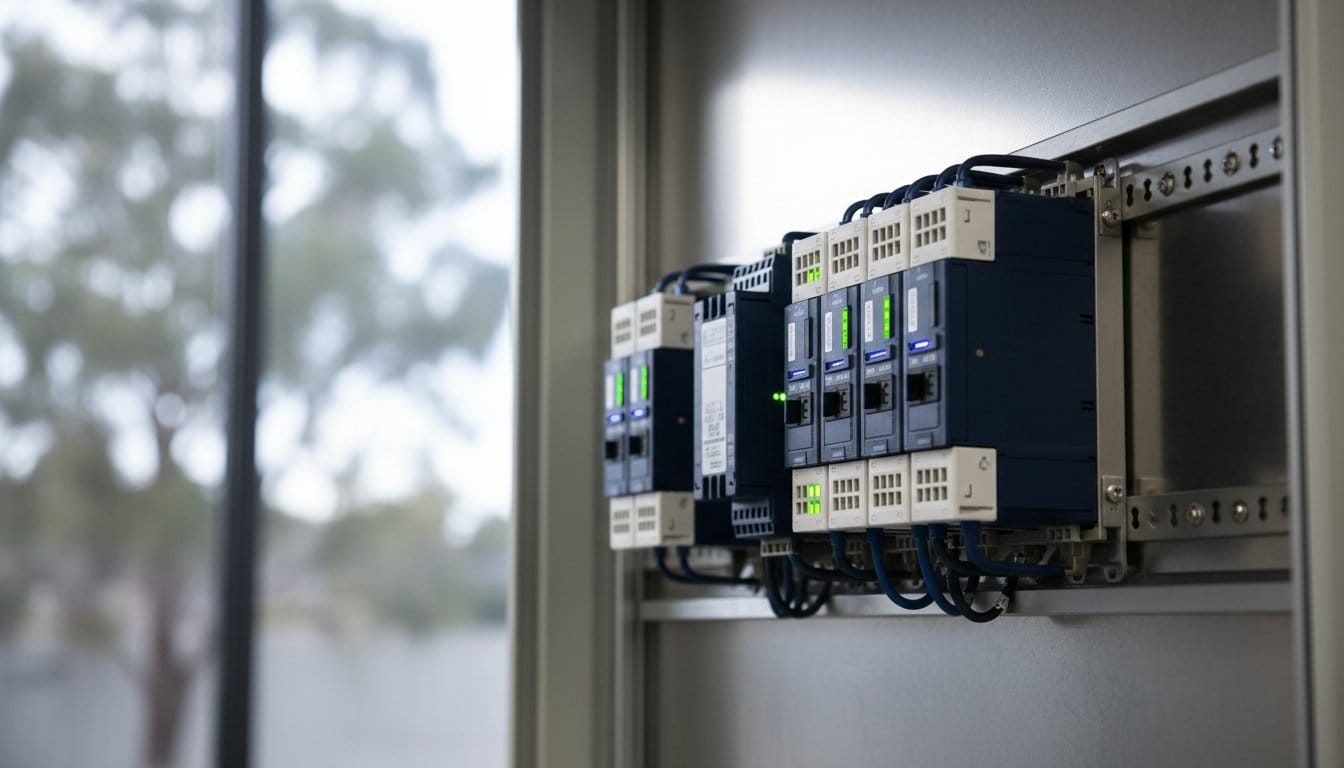
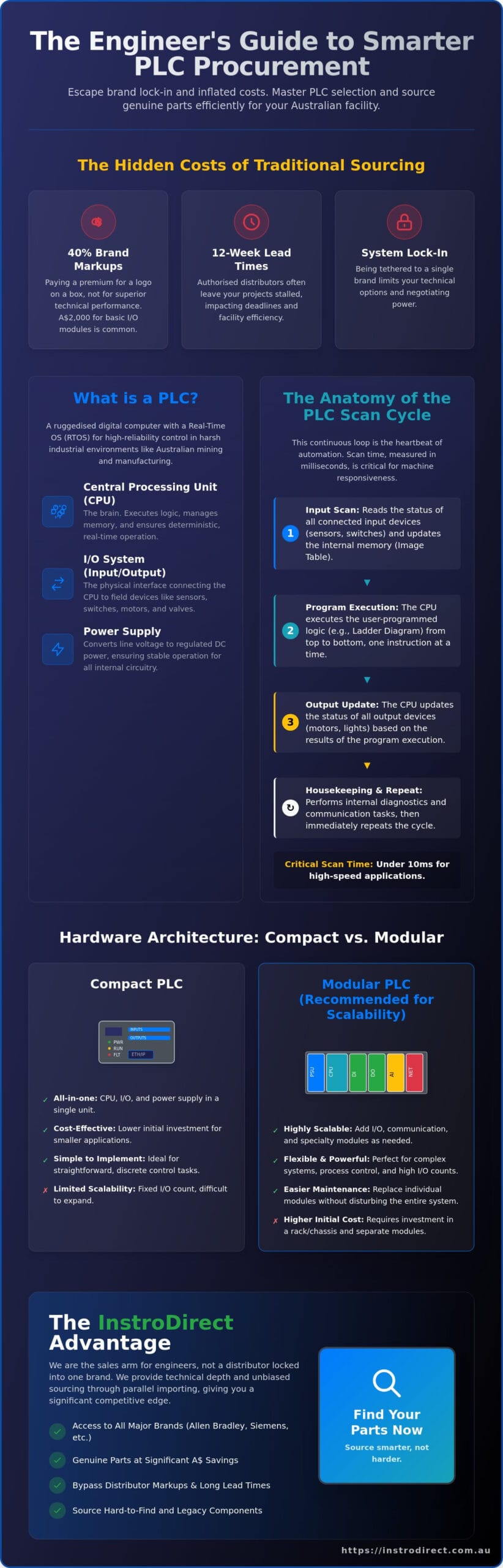
Paying a 40% markup just for a brand name on a box doesn’t make your automation system any smarter. Most Australian engineers know that being tethered to a single authorised distributor usually means 12-week lead times and inflated costs. When you’re defining what is a programmable logic controller for a new project or replacing a failed rack, you need technical performance, not a sales pitch. You’re likely fed up with proprietary software locks and A$2,000 price tags for basic I/O modules that should cost significantly less.
This guide delivers the technical architecture required to master PLC selection and procurement. We’ll break down internal CPU processing, memory mapping, and IEC 61131-3 programming standards across brands like Allen Bradley, Siemens, and Schneider Electric. You’ll learn how to identify the right hardware architecture and why Instrodirect.com.au is the best sales arm for engineers who aren’t locked into one brand. We’ll show you how to source critical parts without the distributor tax and keep your Australian facility running efficiently.
Key Takeaways
- Deep dive into what is a programmable logic controller, focusing on ruggedised hardware and real-time operating systems (RTOS) built for harsh Australian sites.
- Analyze the technical scan cycle to understand how millisecond response times impact the reliability of high-speed automation logic.
- Navigate IEC 61131-3 programming standards and the continued dominance of Ladder Diagram (LD) within the Australian industrial landscape.
- Compare compact versus modular hardware architectures to determine the most cost-effective I/O and networking scalability for your specific requirements.
- Learn why sourcing through Instrodirect.com.au provides a competitive edge, offering genuine parts from all major brands at significant A$ savings via parallel importing.
Defining the Programmable Logic Controller (PLC) in Modern Automation
A Programmable Logic Controller (PLC) is a ruggedised digital computer designed for high-reliability control in harsh industrial environments. Engineers in Australia deploy these units to withstand electrical noise, high vibration, and extreme temperature fluctuations common in mining and manufacturing. When defining what is a programmable logic controller, it’s essential to focus on its deterministic nature. Unlike a consumer PC, a PLC operates on a Real-Time Operating System (RTOS). This ensures that input signals are processed and outputs are triggered within a precise, predictable timeframe, often measured in milliseconds.
The core function of the device involves the continuous monitoring of input devices, such as limit switches, sensors, or encoders. The processor executes logic-based decisions based on a user-defined programme to control output devices like motors, solenoids, and valves. This technology represents a massive evolution from the 1960s-era hard-wired relay logic systems. Modern units are now sophisticated, networked controllers. At Instrodirect.com.au, we provide access to this hardware at lower prices by bypassing traditional distribution markups. We aren’t locked into one brand. This means you get the best technical solution for your specific application, whether it’s Rockwell, Siemens, or Schneider.
The Essential Components of PLC Hardware
Every PLC consists of three primary segments. The Central Processing Unit (CPU) is the brain that executes the logic and manages memory. The Power Supply is critical, converting line voltage to regulated DC for the internal circuitry. Finally, the I/O System acts as the physical interface between field devices and the processor. For those maintaining legacy or high-end systems, Allen-Bradley ControlLogix modules offer the modularity required for complex Australian industrial sites. You can find these at InstroDirect with significant savings compared to manufacturer RRP.
PLC vs. PAC: Understanding the Technical Shift
The industry has shifted toward Programmable Automation Controllers (PACs). While the terms are often used interchangeably, a PAC offers multi-disciplinary capabilities. It handles motion control, process control, and data handling on a single platform. Understanding what is a programmable logic controller today requires recognising that high-end PLCs are technically PACs. They utilise tag-based addressing and advanced networking protocols rather than simple memory mapping.
Choose a traditional PLC for straightforward, discrete control tasks. Select a PAC for complex systems requiring high-speed synchronisation or heavy data integration. InstroDirect serves as your primary sales arm for both. We provide technical depth and unbiased recommendations. If you can’t find the specific series you need, contact us directly. We specialise in sourcing hard-to-find components for the Australian market at the best prices.
How a PLC Works: The Anatomy of the Scan Cycle
The scan cycle is the repetitive heartbeat of industrial automation. It defines how the CPU processes data in a continuous loop. For engineers, understanding this cycle is vital because scan time directly impacts machine responsiveness. In high-speed applications like bottling lines or CNC machining, a scan time exceeding 10ms can result in missed triggers or mechanical collisions. While defining what is a programmable logic controller, we must look at the image table. This temporary memory buffer ensures that input states remain frozen during logic execution. This prevents data inconsistency where an input changes state halfway through the program run.
The Australian PLC market demands high reliability across diverse industries like mining and food processing. Unlike standard cyclic scanning, critical safety functions often utilize interrupt-driven processing. This allows the CPU to halt the main program immediately to handle an emergency stop or a high-speed counter pulse. When selecting what is a programmable logic controller for a specific task, engineers must calculate the total I/O count and required scan speed to ensure the hardware meets the application’s demands.
Step 1: Input Status Monitoring
The CPU first scans every physical input point in the I/O drawer. Digital signals undergo debouncing, usually a 1ms to 8ms filter, to eliminate electrical noise from mechanical switches. For sensors like pressure transmitters, the PLC performs Analogue-to-Digital Conversion (ADC). This translates a 4-20mA or 0-10V signal into a 12-bit or 16-bit integer for the processor. Instrodirect.com.au stocks various I/O modules for brands like Allen Bradley and Schneider to suit these specific signal requirements.
Step 2: Logic Execution and Memory Mapping
The CPU executes the user program instruction by instruction based on the input image. Memory is split into three distinct zones. Firmware lives in ROM. Real-time data, timers, and counters reside in RAM for fast access. The user program is stored in non-volatile memory to prevent data loss during power failures. The CPU handles internal bits and data registers to track machine states across multiple cycles. Instrodirect.com.au provides technical support to help you select the right memory capacity for complex logic.
Step 3: Output Image Update
Once the logic is solved, the CPU writes results to the output image table. These values then transfer to physical output modules to energise solenoids, contactors, or motors. The cycle finishes with housekeeping tasks. This includes diagnostic checks, communication with HMIs, and resetting the watchdog timer. If the scan takes too long, the watchdog trips the system for safety. Because Instrodirect.com.au is not locked into one brand, you can source the exact CPU performance level needed for your specific scan time requirements. Check our latest stock for competitive pricing on high-speed processors.
PLC Programming Standards: Beyond Ladder Logic
The IEC 61131-3 standard defines the global framework for industrial automation. It ensures that Programmable Logic Controller (PLC) systems follow a consistent logic structure regardless of the manufacturer. Understanding what is a programmable logic controller requires a deep dive into the software standards that govern its operation. In Australia, Ladder Diagram (LD) remains the dominant choice for 85% of industrial sites. Electricians and maintenance techs prefer LD because it mimics traditional relay logic, making troubleshooting fast and intuitive. It’s the standard for a reason; it works for simple interlocking and digital logic.
Modern engineering demands more than just basic switching. Structured Text (ST) is gaining ground for complex mathematical algorithms and data handling that would be unreadable in ladder logic. ST uses a high-level, Pascal-like syntax, which is perfect for scaling raw analogue signals or managing high-speed data arrays. Function Block Diagram (FBD) provides a visual approach for process control. It allows engineers to build reusable logic modules, which can reduce commissioning time by up to 25%. InstroDirect stocks hardware supporting all these languages, from Allen-Bradley to Schneider Electric. We aren’t locked into one brand, giving you the flexibility to choose the best platform for your code requirements.
Comparing IEC 61131-3 Languages
Sequential Function Chart (SFC) is the best choice for visualising complex step-by-step processes or state machines. It breaks down a process into specific steps and transitions, simplifying diagnostics in large-scale plants. Instruction List (IL) is a low-level, assembly-like language. Most modern standards now consider IL deprecated because it’s difficult to maintain and read. Engineers must match the language to the application. Use ST for calculations, FBD for regulatory control, and LD for digital interlocks. InstroDirect provides a wider selection of solutions than official channels, ensuring you get the right hardware for your specific language needs. Check our online shop for competitive pricing on multi-language capable controllers.
The Role of the Programming Device
Programming requires a dedicated interface between your PC and the PLC hardware. Modern systems use Ethernet/IP or USB 2.0, while legacy hardware often relies on serial connections like RS-232. Software environments like Studio 5000 for Allen Bradley ControlLogix, TIA Portal for Siemens, and EcoStruxure Machine Expert for Schneider provide the development workspace. Online editing allows you to modify code while the system is running. This is critical for 24/7 operations in Australia where unplanned downtime can cost upwards of A$10,000 per hour. Offline editing is safer for major logic overhauls. We offer technical gear that supports both methods, helping you manage live system updates safely and efficiently. If you can’t find the specific programming cable or controller you need, ring us directly. We are here to help you source hard-to-locate parts at the best prices.
Hardware Architecture: Selecting Modular vs. Compact PLCs
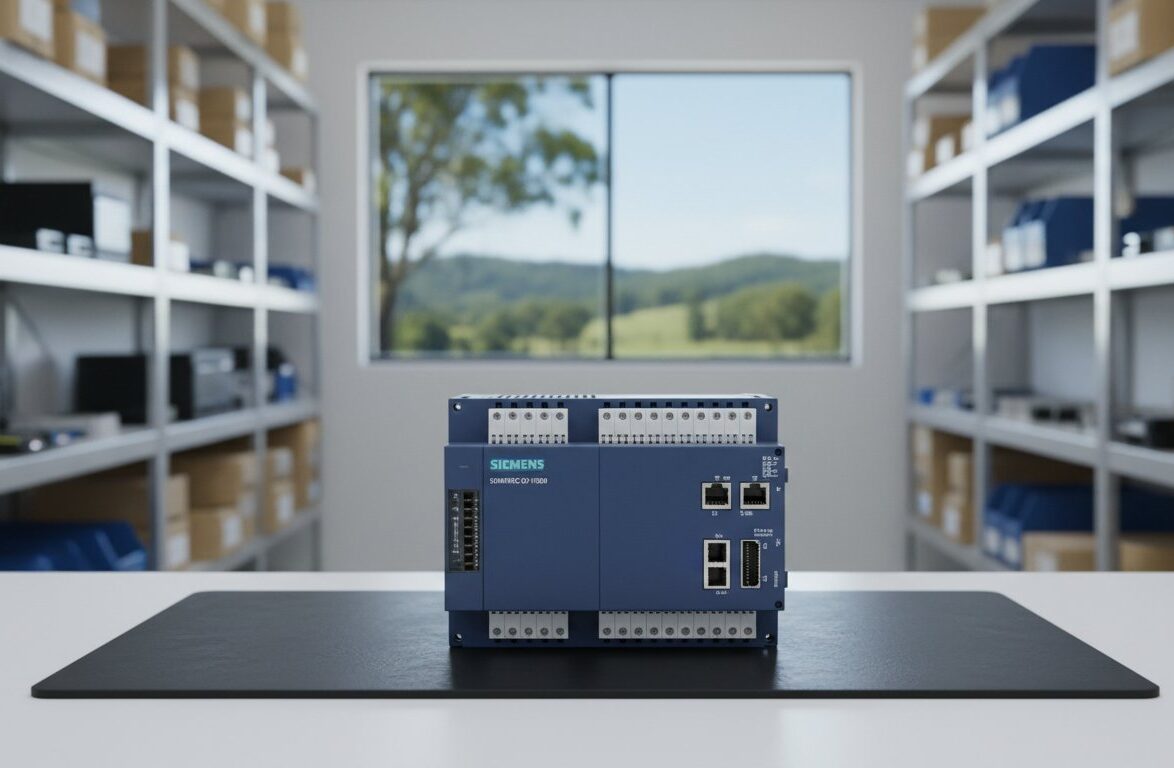
Choosing the right hardware architecture is the first step in defining what is a programmable logic controller for your specific project. Engineers generally choose between two formats: compact and modular. Compact PLCs, or “brick” systems, house the CPU, power supply, and I/O in a single fixed enclosure. These units are cost-effective for small-scale automation like pump control or standalone packaging machines where I/O requirements don’t exceed 40 to 60 points. They save space but offer limited expansion once the internal terminals are full.
Modular PLCs utilize a backplane or rack-based system. This architecture allows you to mix and match modules based on the application’s complexity. You can scale from 16 I/O points to several thousand. Technical factors drive this selection. A high-performance processor might offer 3MB to 40MB of user memory; while communication ports like dual-port EtherNet/IP allow for DLR (Device Level Ring) topologies. Environmental ratings are vital for Australian conditions. Hardware installed in the Pilbara or Queensland’s heavy industry must handle ambient temperatures up to 60°C and often require IP65 or IP67 ratings to prevent dust and moisture ingress.
Modular System Advantages for Scaling
Modular systems excel in high-availability environments. Hot-swapping allows you to replace a faulty I/O module while the CPU remains in run mode; this minimizes expensive downtime in 24/7 operations. You can also distribute I/O by placing remote racks closer to the field sensors. This reduces copper cabling costs by thousands of A$ as you only run a single industrial Ethernet cable back to the main controller. Specialty modules like high-speed counters for encoders or GPS modules for millisecond-accurate time stamping provide capabilities that compact units can’t match.
Brand Ecosystems and Interoperability
The Australian market has clear brand preferences. Rockwell Automation and Allen-Bradley lead the mining, oil, gas, and food sectors. Their Allen-Bradley ControlLogix platform is the standard for large-scale modular integration. Siemens and Schneider Electric provide alternative architectures often found in global OEM machinery or water treatment plants.
InstroDirect remains brand-agnostic. We don’t push a single manufacturer because we aren’t tied to restrictive local distribution agreements. We use parallel importing to secure lower pricing across all major brands. This ensures you get the best technical fit for your project requirements rather than what a single-brand rep needs to sell. If you’re looking for specific hardware at a better price point, you can shop our full range of PLC hardware and modules. Our focus is on value and efficiency for the Australian engineer.
Strategic Sourcing: Navigating the Australian PLC Market
Engineers in Australia often face a 30% to 50% “local premium” when sourcing automation hardware through traditional channels. The “Authorised Distributor” myth suggests these are the only safe sources for hardware. This isn’t the case. InstroDirect utilizes a parallel importing model to bring genuine, factory-sealed components into the Australian market at significantly lower price points. Understanding what is a programmable logic controller sourcing advantage means looking past the marketing of big distributors to find real value. When asking what is a programmable logic controller procurement strategy worth to your bottom line, the answer is found in supply chain efficiency.
Our Queensland-based warehouse holds local stock to bypass the 12 to 26-week lead times that currently plague the industry. We provide a single point of contact for multiple ecosystems. You aren’t locked into one brand here. We supply Allen Bradley, Siemens, and Schneider Electric hardware from one source. This allows for unbiased technical decisions based on project requirements rather than distributor quotas. We focus on direct, transactional efficiency for engineers who know their specifications.
Optimising Your Automation Budget
Savvy engineers can SAVE OVER 40% FROM MANUFACTURER RRP by opting for direct import models. Every unit is genuine hardware. We guarantee authenticity on all PLCs, VSDs, and I/O modules. Lowering your hardware CAPEX directly improves project ROI. It makes automation upgrades feasible for smaller facilities or tight maintenance budgets. If you’re building a control skid or upgrading a plant, these savings scale quickly. We focus on big deals and best prices for technical professionals who know exactly which part number they need.
Expert Support for Australian Engineers
Sourcing legacy hardware is a major challenge for Australian industry. We specialise in finding exact replacement parts for older systems that authorised channels have marked as end of life. If you’re looking for a specific ControlLogix module or a PowerFlex drive and it isn’t listed, don’t waste time. IF YOU CANT FIND IT RING US WE ARE HERE TO HELP. We provide direct communication for technical sourcing that goes beyond a standard web store. You get the parts you need without the corporate overhead. Ring us directly when you can’t find a part online.
Scale Your Automation with Precision Hardware
Mastering the scan cycle and selecting the right modular or compact architecture defines your system’s reliability. Understanding what is a programmable logic controller goes beyond the basics; it’s about hardware performance and programming flexibility. InstroDirect isn’t locked into one brand. We give you unbiased access to the best technical solutions for your specific engineering challenges. Our focus is simple: genuine parts, lower pricing, and fast delivery.
Secure genuine Rockwell, Siemens, and Schneider Electric hardware from our local stock. Save over 40% from Manufacturer RRP through our parallel importing model. We provide expert Australian-based support to help you navigate specific product codes and technical specs. Don’t let official distribution markups drain your project budget. If you can’t find what you’re looking for, ring us directly. We’re here to help you source exactly what your facility requires.
SAVE ON GENUINE PLCs – SHOP NOW
Get the technical edge your facility deserves today.
Frequently Asked Questions
What is the primary difference between a PLC and a standard computer?
A PLC differs from a standard computer through its deterministic operating system and industrial-hardened hardware. Standard PCs aren’t designed for 24/7 operation in 50°C environments with high electromagnetic interference. PLCs execute logic in a continuous scan cycle to ensure predictable response times. InstroDirect supplies these robust controllers from top brands at the best prices for Australian engineers.
Can I use a PLC for home automation applications in Australia?
Yes, engineers often use compact PLCs like the Siemens LOGO! or Schneider Zelio for high-end Australian home automation projects. These devices handle 240V AC switching more reliably than consumer-grade smart hubs. InstroDirect provides these components at lower pricing compared to retail channels. It’s a robust solution for controlling HVAC and lighting systems across residential sites. Shop now for the best deals.
How do I choose between an Allen-Bradley and a Siemens PLC?
The choice depends on existing site standards and programming preferences. Allen-Bradley dominates 70% of the Australian mining sector with Studio 5000 software. Siemens is a global leader preferred for complex machinery using TIA Portal. Instrodirect.com.au offers both brands, so you aren’t locked into one vendor and can save over 40% on specific modules. We provide unbiased options for your specific technical needs.
What are the main types of I/O modules used in industrial PLCs?
Industrial PLCs primarily use digital and analog I/O modules to communicate with field hardware. Digital modules process on/off signals, while analog modules handle variable data like 4-20mA loops. When asking what is a programmable logic controller, it’s vital to recognize these modules as the interface between the CPU and the physical world. InstroDirect stocks a wide range of I/O for ControlLogix and Simatic systems.
Why are PLCs preferred over microcontrollers like Arduino for industry?
PLCs are preferred for industrial applications because they meet IEC 61131-3 standards and offer superior electrical isolation. Arduinos lack the hardened circuitry to survive 24V industrial spikes or EMI. A PLC provides modularity and hot-swappable I/O, which is critical for minimizing downtime in Australian factories. Professional engineers choose PLCs for long-term reliability and certified safety ratings. IF YOU CANT FIND IT RING US WE ARE HERE TO HELP.
How does parallel importing affect the warranty and authenticity of a PLC?
Parallel importing at InstroDirect ensures you get authentic hardware while saving over 40% from manufacturer RRP. We source genuine Siemens and Allen-Bradley parts through global supply chains to bypass local markups. This doesn’t affect the product’s physical authenticity. We provide a full replacement warranty on all items. It’s the smartest way for Australian firms to source hard-to-find parts quickly and efficiently.
What is a “Safety PLC” and when is it required by Australian standards?
A Safety PLC includes redundant processors and internal diagnostics to meet AS/NZS 4024.1 safety standards. These are required when a risk assessment identifies a Category 3 or 4 hazard level in a machine circuit. Standard PLCs cannot be used for emergency stop or light curtain monitoring in high-risk zones. Instrodirect.com.au stocks GuardLogix and F-series CPUs for these critical applications. All brands at the best prices.
How much does a typical industrial PLC cost in Australia?
Typical costs for a micro PLC in Australia range from A$250 to A$900. Large-scale modular systems for mining or manufacturing can cost between A$5,000 and A$20,000 depending on the I/O count. InstroDirect offers lower pricing by leveraging parallel imports. Cant find what your looking for, contact us directly for a quote. You save more when you bypass traditional distribution channels.
Leave a Comment
Your email address will not be published. Required fields are marked *